You are here
- Home
- Publicaties en verslagen
- Landspecifieke verslagen
- Inventory of lifelong guidance systems and practices - Slovenia
Inventory of lifelong guidance systems and practices - Slovenia
| Please cite as: | Cedefop. (2025). Inventory of lifelong guidance systems and practices - Slovenia. CareersNet national records. |
| CareersNet Contributor: | Ema Perme |
| Reviewed by: | Cedefop |
| Copyright: | Reproduction is authorised, provided the source is acknowledged. |
| Disclaimer: | Translations of titles/names for entities, country policies and practices are not to be considered as official translations. The facts and opinions expressed are those of the authors and do not necessarily coincide with the official position of Cedefop. Information supplied by the CareersNet core expert is updated to the best of their knowledge according to the relevant reference period and available information provided by stakeholders and sources consulted. The records have not been edited by a professional English language service. (Last updated August 2026) |
| Previous versions | 2020 |
Introduction
The national legislation described in this record organises lifelong guidance in Slovenia around two key policy areas: education and employment. Career guidance as a specific concept is not explicitly defined in national legislation. Responsibility for lifelong guidance the Ministry of Education, Science and Youth, which oversees guidance activities in primary and secondary education, higher education, and adult within the education sector lies with education and learning. The Ministry is responsible for ensuring the quality and development of the education system from pre-school to higher education and adult learning.
Guidance services for the labour market population, including unemployed persons, jobseekers, and employed adults, fall primarily within the remit of the Ministry of the Economy, Labour and Sport.
Through its responsibility for labour market and employment policies and through the Employment Service of Slovenia, the Ministry provides career guidance, employment counselling, and career development support to jobseekers and workers. It also contributes to lifelong guidance for students and young people by supporting transitions between education and employment and by promoting employability and occupational qualifications.

Figure: Lifelong guidance and career development regulations in education and labour market and employment policy. Source: Based on 10 October 2022, internal report, Slovenian Ministry of Education
The roles of the two policy areas of lifelong guidance are defined by national guidelines and legislation presented below despite the lack of specific language defining it.
The two Council Resolutions (Council of the European Union 2004; 2008) have played a critical role in the development of lifelong guidance in Slovenia. Focus has therefore been placed on the priority areas in the 2008 Resolution, which are to promote the lifelong development of career management skills, to make guidance accessible to all individuals, to develop quality assurance systems in guidance, and to foster coordination and cooperation between national, regional and local actors.
Slovenia has integrated the relevant EU directives into guidelines, sectoral legislation, sectoral guidelines and, finally, into implementation, through several key documents.
The Slovenian Development Strategy 2030 (Strategija razvoja Slovenije 2030) emphasises a knowledge-based society and the close links between knowledge and economic development, community development and active citizenship (Šooš et al., 2017).
Sectoral strategies, such as the Strategy of the Republic of Slovenia for short-cycle higher vocational education 2020–2030 ( Strategija višjega strokovnega izobraževanja v Republiki Sloveniji za obdobje 2020–2030). One of the objectives of higher vocational education by 2030 is: “Increase the participation of older people in lifelong learning to improve employability and enable lifelong career orientation towards development and change.” ((Strategija razvoja Slovenije 2030).
The umbrella policy concerning lifelong guidance in education is set out in the White Paper on Education in the Republic of Slovenia 2011 (Bela knjiga o vzgoji in izobraževanju v Republiki Sloveniji 2011). Chapter 3.9 of the paper introduces a modern understanding of the concept of career guidance as the lifelong development of a person through the perspectives of education, profession, career, and work. It stresses the importance of guidance activities in supporting the implementation of all education stages and levels, from preschool to higher vocational education including adult learning (Krek & Metljak, 2011). The White Paper on Education is complemented by relevant legal bases, which underpin the implementation of the public interest through public services:
The Organisation and Financing of Education Act (Zakon o organizaciji in financiranju vzgoje in izobraževanja (ZOFVI-UPB5)) (Official Gazette of the Republic of Slovenia, No. 16/07) is an umbrella law that i) defines the activities of the guidance service in the field of education, ii) regulates the profession of guidance workers (Article 67), and iii) links the education and labour market policy with the public service provided by the Employment Service of Slovenia.
The legislation regulating each level and type of formal education includes, among its objectives, career guidance, equipping individuals for lifelong learning, career planning and development, and vocational decision-making:
- The Basic School Act (Zakon o osnovni šoli (ZOsn)) (Official Gazette of the Republic of Slovenia, No. 81/06) defines among its objectives (Article 2) the acquisition of abilities for further educational and vocational development, with an emphasis on competencies for lifelong learning.
- Article 2 of the Gymnasium Act (Zakon o gimnazijah (ZGim)) (Official Gazette of the Republic of Slovenia, No 1/07) defines the role of upper secondary education (gymnasiums) in young people's career decisions.
- The Vocational Education Act (Zakon o poklicnem in strokovnem izobraževanju (ZPSI-1)) (Official Gazette of the Republic of Slovenia, No. 79/06) provides in Article 2 that vocational education and training shall, among other things, promote lifelong learning, career planning and career management.
- The Article 24 of the Adult Education Act (Zakon o izobraževanju odraslih (ZIO-1)) (Official Gazette of the RS, No 6/18) integrates lifelong career guidance activities in the process of adult education.
The legislation outlined below defines the provision of career guidance at different levels and types of formal education. The practical basis for its implementation at each level of education is elaborated by the National Education Institute Slovenia and at the level of adult education by the Slovenian Institute for Adult Education.
The Program guidelines for counselling practice in the field of education and training (Programske smernice svetovalnega dela v programih s področja vzgoje in izobraževanja) launched in June 2024 (presented to the General Education Council of the Republic of Slovenia) reflecting advancements in pedagogical, psychological, and social sciences. It aims to support the comprehensive development and well-being of children and adolescents through structured, inclusive, and preventive approaches across kindergartens, basic schools, secondary schools, and dormitories. The guidelines emphasize collaboration among stakeholders and provide a framework for professional autonomy and ethical practices tailored to individual needs, abilities, interest and institutional goals.
The Guidelines provide a unified concept of school counselling work, applicable to all counselling professionals working with pupils and young people in preschool, school and in public dormitory settings, regardless of their studies and diplomas or specialization (such as Education Science, Psychology, Social Work, Social Pedagogy, Rehabilitation Education, Inclusive Pedagogy). They serve as a framework for professional activities, allowing each educational institution and school counsellor to flexibly adapt to the diverse specific needs of pupils (ranging from cognitive, physical and other disabilities, related to disorders and/or impairments) and environmental characteristics (urban/rural; special education programme for children with a moderate to severe needs). School counsellors select priority tasks within defined areas based on their expertise and develop an annual work plan aligned with legislation and the institution's strategic documents (e.g., development and operational plans).
The five core areas of counselling work include:
- Creating a safe, stimulating, and inclusive environment;
- Promoting holistic development and well-being of children in kindergarten and pupils (basic schools) and students in secondary schools and dormitories;
- Supporting play and learning (in kindergartens) or teaching and learning (in schools and dormitories);
- Managing transitions, such as onboarding newcomers and facilitating shifts to another level of education or a different educational program. This is based on ensuring well-planned, systematic, and professionally guided transitions to successfully integrate students into a new school environment, class, or group. It includes when students first enter the educational process, move between school years, or advance to higher levels of education, all of which should be supported;
- Co-creating a plan for implementing career orientation in collaboration with professional staff and parents (e.g., parent meetings, preparing an implementation plan for lessons)
- Career orientation (exploring and developing interests and abilities)
- Contributing to institutional growth and professional development.
School counsellors provide developmental and preventive support, as well as direct assistance, through collaboration with children, students, educators, school leaders, parents, external institutions, and other experts. In the schooling context, it includes the co-creation of a plan for career orientation with relevant staff and parents. In secondary school, tasks include career orientation, exploring and developing interests and abilities.
The Guidelines for Implementing Adult Education Guidance as a Public Service encompasses three areas of adult education: integration into and continuation of education, identification and validation of knowledge and skills, and self-directed learning. This document specifies the starting points for the definition of guidance in adult learning and education, the content, organisation, staff and other conditions for implementation, records and documentation, as well as quality evaluation and development (Dovžak et al., 2020).
Within the social policy of the labour market, lifelong guidance is defined and set out in several documents.
Labour Market Regulation Act (Zakon o urejanju trga dela (ZUTD)) (Official Gazette of the Republic of Slovenia, No. 80/10): The Act defines the purpose, objectives, content and organisation of the lifelong career guidance system of the Employment Service of Slovenia – the central national institution responsible for lifelong career guidance and employment brokerage (Article 16). It introduces a modern understanding of lifelong career guidance as a system of “activities enabling the identification of skills, competences and interests for making decisions in the fields of employment, education, training and vocational choice, and enable guidance through various paths of life in such a manner that individuals learn and use these skills and competences” (Article 18). The objective of the Act is “to establish a network of lifelong career guidance providers and employment brokerage, which shall enable the free choice of employment or vocation to comply with an individual’s competences and employment opportunities, and to achieve the highest employment rate possible” (Article 3).
A specific aspect of lifelong guidance for the unemployed is regulated by the Active Employment Policy Measures Programme (Ukrepi aktivne politike zaposlovanja), which defines guidelines for the unemployed or job seekers, such as preparation for self-employment or independent entrepreneurship.
Lifelong guidance for specific target groups is governed by sectoral legislation. One example is the target group of persons serving prison sentences. The Enforcement of Criminal Sanctions Act (Zakon o izvrševanju kazenskih sankcij (ZIKS-1)) (Official Gazette of the Republic of Slovenia, No 110/06) thus ensures the provision of guidance and education, or the planning and acquisition of competencies/formal education while a person is serving a prison sentence. Penal institutions must provide education and vocational training for convicted persons, and in doing so, "the choice of the education programme and the convicted person's occupation must take into account their abilities and inclinations, the facilities of the institution and other circumstances.” (Article 102).
The two social policies in the education and the labour market sectors are closely intertwined in implementing lifelong guidance. According to the interviews conducted (10 October 2022, internal report, Slovenian Ministry of Education) with key stakeholders, in the historical development of the field of career guidance a critical role is ascribed to labour market policy with the cooperation of the Employment Service of Slovenia. However, as the understanding of ‘lifelong career guidance’ has evolved, an interlinked system emerged, helping to ensure the cooperation and coordination of various stakeholders in the lifelong guidance system.
Sources
- Cedefop, & Institute of the Republic of Slovenia for Vocational Education and Training (CPI). (2023). Vocational education and training in Europe - Slovenia: system description. In Cedefop, & ReferNet. (2024). Vocational education and training in Europe: VET in Europe database - detailed VET system descriptions [Database]. https://www.cedefop.europa.eu/en/tools/vet-in-europe/systems/slovenia-u3
- Državni zbor Republike Slovenije [National Assembly]. (2018). Zakon o izobraževanju odraslih (ZIO1) [Adult Education Act].. Uradni list RS, št. 6/18. https://www.uradni-list.si/glasilo-uradni-list-rs/vsebina/2018-01-0222?sop=2018-01-0222
- Državni zbor Republike Slovenije [National Assembly].(2006).Zakon o osnovni šoli (ZOsn) [Basic School Act]. Uradni list RS, št. 81/06. https://www.uradni-list.si/glasilo-uradni-list-rs/vsebina/2006-01-3535?sop=2006-01-3535
- Council of the European Union (2004). Draft Resolution of the Council and of the representatives of the Member States meeting within the Council on Strengthening Policies, Systems and Practices in the field of guidance throughout life in Europe (8448/04 EDUC 89 SOC 179). https://data.consilium.europa.eu/doc/document/ST%209286%202004%20INIT/EN/pdf
- Council of the European Union (2008). Resolution of the Council and of the Representatives of the Governments of the Member States, meeting within the Council of 21 November 2008 on better integrating lifelong guidance into lifelong learning strategies (2008/C 319/02). http://eur-lex.europa.eu/LexUriServ/LexUriServ.do?uri=OJ:C:2008:319:0004:0007:EN:PDF
- Rupar Brigita, et al. (2024). Programske smernice svetovalnega dela v programih s področja vzgoje in izobraževanja [Guidelines for Counselling Practice in Education Programs]. National Education Institut Slovenia. https://www.gov.si/assets/ministrstva/MVI/Dokumenti/Srednja-sola/Programske-smernice-svetovalnega-dela-v-programih-s-podrocja-vzgoje-in-izobrazevanja.pdf
- Dovžak, K., et al. (2020). Guidelines for implementing adult education guidance as a public service. Slovenian Institute for Adult Education. https://www.acs.si/en/digital-library/guidelines-for-implementing-adult-education-guidance-as-a-public-service/
- Government of the Republic of Slovenia (2024). Katalog ukrepov aktivne politike zaposlovanja [Active Employment Policy Measures Programme]. https://www.gov.si/teme/aktivna-politika-zaposlovanja
- Državni zbor Republike Slovenije [National Assembly]. (2006). Zakon o izvrševanju kazenskih sankcij (ZIKS-1) [Enforcement of Criminal Sanctions Act ] . Uradni list RS, št. 110/06. https://www.uradni-list.si/glasilo-uradni-list-rs/vsebina/2006-01-4665?sop=2006-01-4665
- Državni zbor Republike Slovenije [National Assembly]. (2007) Zakon o gimnazijah (ZGim) [Gymnasium Act ] Uradni list RS, št. 1/07. https://www.uradni-list.si/glasilo-uradni-list-rs/vsebina/2007-01-0002?sop=2007-01-0002
- Krek, J. & Metljak, M. (Eds.). (2011). Bela knjiga o vzgoji in izobraževanju v RS [White Paper on Education in the Republic of Slovenia 2011 ]. National Education Institute Slovenia. https://pismenost.acs.si/wp-content/uploads/2017/09/Bela-knjiga-o-vzgoji-in-izobra%C5%BEevanju-v-RS-2011.pdf
- Državni zbor Republike Slovenije [National Assembly]. (2010). Zakon o urejanju trga dela (ZUTD) [ Labour Market Regulation Act]. Uradni list RS, št. 80/10. https://www.uradni-list.si/glasilo-uradni-list-rs/vsebina/2010-01-4304?sop=2010-01-4304
- Državni zbor Republike Slovenije [National Assembly]. (2007). Zakon o nacionalnih poklicnih kvalifikacijah (ZNPK) [National Professional Qualification Act]. Uradni list RS, št. 1/07. https://www.uradni-list.si/glasilo-uradni-list-rs/vsebina/2007-01-0004?sop=2007-01-0004
- Državni zbor Republike Slovenije [National Assembly]. (2007). Zakon o organizaciji in financiranju vzgoje in izobraževanja (ZOFVI) [Organisation and Financing of Education Act ].Uradni list RS, št. 16/07. https://www.uradni-list.si/glasilo-uradni-list-rs/vsebina/2007-01-0718?sop=2007-01-0718
- Šooš, T., et al. (Eds). (2017). Strategija razvoja Slovenije 2030 [Slovenian Development Strategy 2030]. Služba Vlade Republike Slovenije za razvoj in evropsko kohezijsko politiko]. https://www.gov.si/assets/vladne-sluzbe/SVRK/Strategija-razvoja-Slovenije-2030/Strategija_razvoja_Slovenije_2030.pdf
- Vlada Republike Slovenije [Government of Republic of Slovenia] (2020). Strategija višjega strokovnega izobraževanja v Republiki Sloveniji za obdobje 2020–2030 [Strategy of the Republic of Slovenia for short-cycle higher vocational education 2020–2030]. https://www.gov.si/assets/ministrstva/MIZS/Dokumenti/Visje-strokovno-izobrazevanje/Strategija-visjega-strokovnega-izobrazevanje-RS-2020-2030/Strategija-visjega-strokovnega-izobrazevanja-v-Republiki-Sloveniji-za-obdobje-20202030.pdf
- Državni zbor Republike Slovenije [National Assembly]. (2006). Zakon o poklicnem in strokovnem izobraževanju (ZPSI-1) [Vocational Education Act ]. Uradni list RS, št. 79/06. https://www.uradni-list.si/glasilo-uradni-list-rs/vsebina/2006-01-3449?sop=2006-01-3449
- Zakon o osnovni šoli (ZOsn) (2006). Uradni list RS, št. 81/06. https://www.uradni-list.si/glasilo-uradni-list-rs/vsebina/2006-01-3535?sop=2006-01-3535
- Zakon o organizaciji in financiranju vzgoje in izobraževanja (ZOFVI) (2007). Uradni list RS, št. 16/07. https://www.uradni-list.si/glasilo-uradni-list-rs/vsebina/2007-01-0718?sop=2007-01-0718
- Zakon o poklicnem in strokovnem izobraževanju (ZPSI-1) (2006). Uradni list RS, št. 79/06. https://www.uradni-list.si/glasilo-uradni-list-rs/vsebina/2006-01-3449?sop=2006-01-3449
- Zakon o urejanju trga dela (ZUTD) (2010). Uradni list RS, št. 80/10. https://www.uradni-list.si/glasilo-uradni-list-rs/vsebina/2010-01-4304?sop=2010-01-4304
- Zavod RS za zaposlovanje (w.d.). Ukrepi aktivne politike zaposlovanja. https://www.ess.gov.si/_files/410/programi_zaposlovanja.pdf
Coordination and collaboration among stakeholders
In line with the guidelines and the legislation underpinning the different formal settings where career guidance is offered, lifelong guidance is ensuring the individual's holistic development in relation to the development of society. Lifelong guidance is therefore embedded in different policy areas in society such as in education, the labour market, welfare, the economy and other domains.
The lifelong guidance system is organised on an intersectoral basis. Primarily, it integrates the responsibilities, competencies and tasks of the ministries responsible for education, labour, economy and for cohesion policy and development.
The providers of lifelong guidance are basic schools (Basic School Act (ZOsn) (single structure 9-year compulsory education (osnovna šola), ISCED 1 (primary education) and ISCED 2 (lower secondary education); secondary schools (Gymnasium Act (ZGim); Vocational Education Act (ZPSI-1), Adult Education Act (ZIO-1), higher vocational colleges Higher Vocational Education Act (ZVSI), higher education institutions, , the Employment Service of Slovenia (Labour Market Regulation Act), mainly through Career Centres (Karierna središča) and Regional Offices, public services of adult education counselling operating in different public institutions and adult education centres (former regional guidance centres for adult education – IGAE centres), companies or employers (Employment Relationships Act (Zakon o delovnih razmerjih (ZDR1), Official Gazette of the RS, No 21/13)), Slovenian Social Work Centres (Centri za socialno delo Slovenije) and others.
Guidance services are generally designed to be inclusive of the diverse users. They include compulsory basic and secondary school pupils, students, the unemployed, the employed, early school leavers from education and training (ELET), and other groups whose inclusion in is ensured by sectoral regulations and different institutions. The public institutions included are not only those primarily responsible for a specific user groups but also for generic services (e.g. career development service in different public organizations, such as schools, universities, public adult education Centres and PES for vulnerable groups). Service users are also persons serving prison sentences, persons outside the education system, training or employment, young people from at-risk groups, persons with disabilities, immigrants, and refugees, but also guidance providers. The users of the lifelong guidance system are also those who are providing career guidance, such as career counsellors.
The national public institutions for education and employment, established by the Government of the Republic of Slovenia that are responsible for the providers of lifelong guidance services are i) the National Education Institute Slovenia, ii) Institute of the Republic of Slovenia for Vocational Education and Training, iii) Employment Service of Slovenia, iv) Slovenian Institute for Adult Education, v) Public Scholarship, Development, Disability and Maintenance Fund of the Republic of Slovenia, vi) University of Ljubljana, vii) University of Primorska, viii) University of Maribor, ix) University of Nova Gorica.
Cross-sectoral cooperation between relevant labour market and education policies in the area of lifelong guidance is set out in the Organisation and Financing of Education Act (ZOFVI) (Official Gazette of the Republic of Slovenia, No. 16/07), which links guidance activities for pupils (the education policy) with the labour market policy (Employment Service of Slovenia), by stipulating that guidance workers in the formal education system shall cooperate with the Employment Service of Slovenia in the provision of career guidance services. However, as lifelong guidance is a multidimensional and multilevel concept benefitting from central coordination for coherence, intersectoral cooperation and coordination are currently realised through the National expert group for lifelong career guidance (Nacionalna strokovna skupina za vseživljenjsko karierno orientacijo).
The National Expert Group for Lifelong Career Guidance was appointed by a decision of the Minister of Education, Science and Youth, the most recent mandate for the period 2021–2025. Members of the National Expert Group are representatives of the relevant ministries
responsible for education, labour, economy and for cohesion policy and development; National public organisations for education: National Education Institute of Slovenia, Institute of the Republic of Slovenia for Vocational Education and Training, Slovenian Institute for Adult Education, Employment Service of Slovenia, Public Scholarship, Development, Disability and Maintenance Fund of the Republic of Slovenia; University of Ljubljana, Association of Slovene Higher Vocational Colleges, and NGO, Association for Career Guidance of Slovenia.
The National Expert Group focuses on the systemic regulation of lifelong guidance in Slovenia, the development of the field and professional development, quality assurance, networking and cooperation with national and international partners, dissemination of project results, materials, and recommendations, and other activities in the field of lifelong career guidance. It is an expert body ensuring that the various departments and actors share information, cooperate and develop guidelines and recommendations to make the activities more effective and beneficial for all target user groups at a national level. Intersectoral integration is further ensured through operational structure and organisation through work in different subgroups in an intersectoral manner and involving diverse stakeholders. Thus, individual task areas are the responsibility of subgroups: the system subgroup, the quality assurance subgroup, the communication subgroup, the international integration subgroup, and the professional development subgroup. Each is tasked with a specific target user group (e.g. primary or secondary school pupils, students, the unemployed, the employed, etc.) and organises cooperation with external partners. While the individual lifelong guidance provision for each target group functions as relatively autonomous sub-systems, they are guided and monitored through national legislation and guidelines in their respective fields (e.g., the basic school and secondary school Guidelines for School Counsellors, Guidelines for Implementing Adult Education Guidance as a Public Service), as well as by the National Expert Group for Lifelong Career Guidance.
Key stakeholder interviews (16th June 2021, Decision of the minister of education on the National Expert Group for Lifelong Guidance), underlined that the Group is a professional, rather than a decision-making body. Accordingly, interviewees agreed that in order to ensure the further development of the field of lifelong guidance, especially concerning cross-sectoral cooperation and implementation at the local level, the group would benefit from having specific responsibilities and decision-making power in providing proposals to policy makers.
After the project ended in 2022 (an ESF project under the 2014–2020 period titled National Coordination Point for Lifelong Career Guidance) (Nacionalna koordinacijska točka vseživljenjske karierne orientacije), the Employment Service of Slovenia assumed technical support, including website editing, for the National Expert Group active since 2010. The previous project was part of the 2007–2013 Operational Programme for Human Resources Development. Under the 2014–2020 EU Cohesion Policy Programme, the Coordination Point continued through the original project Service Development of Lifelong Career Guidance and Strengthening of the National Coordination Point, aiming to support systemic development and regulation of lifelong career guidance in Slovenia. The project was co-financed by the European Social Fund and implemented by the Employment Service of Slovenia in close cooperation with relevant partners.
The individual system policies ensure that the guidance system is vertically linked to the local level through concrete activities for specific target groups. Below are three examples of its vertical-horizontal integration:
For staff providing career guidance (and other tasks) in basic and secondary education, the National Education Institute of Slovenia, develops programme documents for teaching and guidance work, syllabuses, and other documents, ensuring the formalisation of lifelong career guidance within the school system. The Institute was established by the Government to oversee education policy arrangements for the Ministry of Education responsible for the professional development and training of those providing guidance (school counsellors or other practitioners). The development of school counsellors' competencies is provided as additional professional training. One of the core tasks of the Institute is to prepare the bases for expert documents and systemic conditions for the development of education, including the integration of lifelong career guidance into the education system (Programske smernice svetovalnega dela v programih s področja vzgoje in izobraževanja, 2024). The Institute publishes a magazine – School Counsellor Work (Šolsko svetovalno delo) – aimed at school counsellors (since 1996). Specific schools (for cognitive, socio-emotional difficulties, mobility and other disabilities or impairments) including their management, teachers and school counsellors cooperate with local stakeholders. This includes the Employment Service of Slovenia with its Regional offices, as well as local institutions and employers, who are hosted or visited by schools in order to share information, learn about careers and provide support in vocational decision-making, either as part of special cross-curricular education days or as part of an elective or compulsory course (examples Luka Koper, d.d. and pupils visit at Krka, d.d.).
Although the implementation of the guidance system in the field of child and youth education has reached the local level, stakeholders interviewed (10 October 2022, Internal report, Slovenian Ministry of Education) stress the need to further integrate career guidance by incorporating the concept and activities into the formal education curricula at different levels. The current system is based more on the proactive efforts of individuals (teachers, school counsellors, school management) rather than the systemic framework itself (ibid).
A comprehensive lifelong guidance system involving vertical and horizontal integration of different actors to the local levels has recently been introduced in adult education. The Adult Education Act (ZIO1) was adopted in 2018 (Official Gazette of the Republic of Slovenia, No. 6/18), which is in keeping with best international and career guidance practice (and supported by the ELGPN 2015 Guidelines). The Adult Education Act defines adult education guidance as a public service. In addition to guidance activities, the service includes a ’Basic school for adults’, which is a project from 2011 focused on enhancing independent learning. The ‘Guidelines for Implementing Adult Education Guidance as a Public Service’ were prepared by the Slovenian Institute for Adult Education. Public service provision of guidance in adult education was established and began its operation on 1 January 2021 (Rules on Norms and Standards for Funding and Provision of Public Service in Adult Education - Pravilnik o standardih in normativih za financiranje in izvajanje javne službe na področju izobraževanja odraslih; Official Gazette of the Republic of Slovenia, No. 180/20). Guidance services in adult education have been provided across Slovenia in 35 adult education organisations since 2022. Coordination, cooperation, implementation and monitoring of lifelong guidance to local levels have also been established, and agreements with varying degrees of commitment, responsibilities and tasks have been made between partners and other actors involved in implementing guidance activities. Feeback is provided through the system for monitoring achievements.
The lifelong guidance system is also established at the local levels in higher vocational and higher education. Higher vocational education is a short-cycle tertiary education. It is a specific two-year study programme that offers 400 hours of practical training each year. Around half of the students in higher vocational education are typically part-time students connected to the labour market whereas full-time students can meet employers through work placements and start developing their career paths through cooperation with potential employers.
The Association of Slovene Higher Vocational Colleges is a community of higher vocational colleges that supports the implementation of lifelong career guidance. Each higher vocational college has its network of employers at the local or regional level with whom it cooperates in the field of lifelong guidance. At the higher education level are university career centres (e.g. the Career Centre of the University of Ljubljana, the Career Centre of the University of Maribor, the Career Centre of the University of Primorska) to i) connect higher education institutions with employers and the wider society, ii) provide individual and group career guidance and lifelong learning for students, and iii) facilitate the transition to the labour market and increase students' employability.
The public Employment Service of Slovenia (ESS) also plays an essential role in ensuring intersectoral cooperation. It focuses on the broad range of target groups and engages with various stakeholders at the implementation level:
The ESS and school staff prepare an annual plan of work with basic school youth, which provides schools with information and career guidance as part of the Employment Service’s Career Centres.
The intersectoral role of the Employment Service of Slovenia (ESS) is enhanced through its membership in Euroguidance network with vocational information and career centres linking guidance workers across Europe. The Ministry of Labour, Family, Social Affairs and Equal Opportunities renewed the Euroguidance Centre in Slovenia as part of the National Vocational Information and Counselling Centre at the Employment Service of Slovenia for the 2021–2027 Erasmus+ period.
The ESS contributes to the development of the competencies of guidance workers in education and employment, the primary target group, and raising awareness of the European dimension of lifelong career guidance, priorities of Euroguidance Centres. The secondary target groups are young people, the unemployed, job seekers and parents, reached through diverse communication tools and activities.
Cooperation with Europass and the Slovenian Qualifications Framework at the Institute of the Republic of Slovenia for Vocational Education and Training aims to strengthen cooperation with the ESS fostering the European dimension of lifelong career guidance. Cooperation since 2016 has been maintained through a working group, training for guidance workers, promotion, study visits and a newsletter.
Strategic communication and networking with national stakeholders promote Euroguidance project results and the ESS is actively involved in the national working groups for the development of the Europass initiative (Institute of the Republic of Slovenia for Vocational Education and Training, and Ministry of Education, Science and Sport) and the implementation of European Transparency Tools (Institute of the Republic of Slovenia for Vocational Education and Training), as well as other activities (e.g. annual meetings of the European Commission networks in Slovenia with the Representation of the European Commission in Slovenia).
International cooperation is assured through active involvement in activities and working groups at the Euroguidance network level.
Further intersectoral cooperation is ensured through projects related to lifelong guidance. The Competence Prediction Platform (Platforma za napovedovanje competence PNK) illustrates strong intersectoral coordination. The project co-financed by the European Social Fund is implemented by the Ministry of Labour, Family, Social Affairs and Equal Opportunities and partners with the ESS. The objective is to develop a web-based tool for the short-, medium- and long-term prediction of labour market needs and to display the correlation between supply and demand to improve the functioning of the labour market. The first phase of the project ran from May 2021 to March 2023 and is long-term (until 2030) aiming to develop a practical tool for linking education, the labour market, economic and development policy to enhance the activities of the Employment Service of Slovenia in forecasting labour market needs.
Sources
- Rupar Brigita, et al. (2024). Programske smernice svetovalnega dela v programih s področja vzgoje in izobraževanja [Guidelines for Counselling Practice in Education Programs]. National Education Institut Slovenia. https://www.gov.si/assets/ministrstva/MVI/Dokumenti/Srednja-sola/Programske-smernice-svetovalnega-dela-v-programih-s-podrocja-vzgoje-in-izobrazevanja.pdf
- Dovžak, K., et al. (2020). Guidelines for implementing adult education guidance as a public service. Slovenian Institute for Adult Education. https://www.acs.si/en/digital-library/guidelines-for-implementing-adult-education-guidance-as-a-public-service/
- Državni zbor Republike Slovenije [National Assembly]. (2013). Zakon o delovnih razmerjih (ZDR1) [Employment Relationships Act ]. Uradni list št. 21/2013. https://www.uradni-list.si/glasilo-uradni-list-rs/vsebina/2013-01-0784?sop=2013-01-0784
- Luka Koper, d.d. (n..d.). Živeti s pristaniščem [Living with the port]. https://www.zivetispristaniscem.si/vodeni-ogledi-pristanisca
- Osnovna šola Zagradec. (2020). Obisk tovarne zdravil Krka z izbirnim predmetom Kemija v okolju [A visit to the Krka pharmaceutical factory with the optional subject Chemistry in the environment]. http://zagradec.splet.arnes.si/2020/10/02/obisk-tovarne-zdravil-krka-z-izbirnim-predmetom-kemija-v-okolju/
- Ministrstvo za izobraževanje, znanost in šport [Ministry of Education, Science and Sport]. (2020).Pravilnik o standardih in normativih za financiranje in izvajanje javne službe na področju izobraževanja odraslih [Rules on Norms and Standards for Funding and Provision of Public Service in Adult Education ].Uradni list RS, št. 180/20. https://www.uradni-list.si/glasilo-uradni-list-rs/vsebina/2020-01-3135/pravilnik-o-standardih-in-normativih-za-financiranje-in-izvajanje-javne-sluzbe-na-podrocju-izobrazevanja-odraslih
Access to guidance
The main advantage of the Slovenian lifelong guidance system cited by various stakeholders interviewed (10 October 2022, Internal report, Slovenian Ministry of Education) is that it is largely accessible as a free public service and also geographically, as services are available to users throughout Slovenia and are implemented in cooperation with local stakeholders. This can arguably be a factor in increasing the effectiveness (especially informal guidance activities) of the service due to their inclusiveness. In addition to the availability of school counsellors for young people in all educational institutions, access to lifelong guidance services is mainly provided to them through the Career Centres for Youth, to students through the Career centres at universities, through Career centres of the Employment Service of Slovenia (for all ages) and to adults also through the 17 Adult Education Guidance Centres across Slovenia until 2020, and from 2021, in 35 Adult Education Guidance Centres which are placed in 35 local Adult Education Centres (i.e. Adult education centre Kranj).

Figure: Access to lifelong guidance throughout formal education. Source: Based on 10 October 2022, internal report, Slovenian Ministry of Education
The access (including accessibility) to lifelong guidance services has been accelerated recently through online tools, utilities and websites where users can access information more quickly. In addition, there are plans to establish a single-entry point in Slovenia for information in all areas of employment, for individuals transitioning between levels of education (e.g. from basic to secondary school, from secondary school to university, etc.). Especially during the pandemic, various organisations have adapted their services (e.g. telephone counselling, video links), though recognising that these formats may not be suitable or accessible for all users. In response to the outbreak of the war in Ukraine, the Slovenia Euroguidance network hosted joint webinars on career guidance for refugees (EU resources and effective approaches to career guidance for refugees). The independent expert for Slovenia in Cedefop’s CareersNet also provided insights for the published ad hoc flyer to promote lifelong guidance for Ukrainian refugees in the EU.
Other developments widening access to guidance services was made with the ‘Summary of professional foundations for building a systemic approach to lifelong career guidance within the Operational Programme 2007-2013’, where underserved target user groups were identified. Based on this, i) career centres for students; ii) lifelong career guidance for employees; iii) career centres for youth; iv) the project ‘Development and promotion of services and tools for lifelong career guidance for unemployed and other job seekers’ were developed and implemented. In addition, v) lifelong guidance in adult learning and education was supported by different instruments of the cohesion policy between 2014-2020 and the vi) National Career Guidance Coordination Point was established.
The establishment of the National Coordination Point widens access to guidance, while key steps were taken between 2006 and 2015 to improve access to information. Career fairs and programme presentations are organised regularly in various towns around Slovenia (all secondary schools and faculties organise annual open days). In the last five years digital services and information through new channels (e.g., social networks) have been expanding, The ‘My Choice’ (Moja izbira) web portal was launched in 2013 and was revamped. The portal is a one-stop shop for users and career guidance practitioners to get information on where and how individuals can engage in career planning. The portal is aimed at young people in education and is also useful for adult learners. Various workshops, training and events (e.g., within the Euroguidance network, Europass and EQF, National Coordination Point Slovenia, activities of the National Institute for Vocational Education and Training) are delivered in person and now online. Extensive materials (e.g. Expand your horizons) are available to career guidance practitioner (counsellors).
Lifelong guidance in schools
The workplace and careers related content are included in the Preschool curriculum (Kurikulum za vrtce) implemented by the relevant professionals. Pupils' access to lifelong guidance services is guaranteed by Article 67 of the sectoral law - The Act on the Organization and Financing of Education (Zakon o organizaciji in financiranju vzgoje in izobraževanja (ZOFVI); Official Gazette of the Republic of Slovenia, No. 16/07), which stipulates that school counsellors should provide vocational counselling. The framework of provision of lifelong guidance for children in preschool education, pupils in basic education and for students in secondary education (general and vocational) is defined in Programske smernice svetovalnega del v programih s področja vzgoje in izobraževanja) for School Counsellors (see also pg. 3).
Guidelines for Counselling Practice in Education Programs for School Counselling in all formal programmes for children and youth (Programske smernice svetovalnega dela v programih s področja vzgoje in izobraževanja ) define the involvement of school counsellors in general and vocational education at all levels in a pubic system from kindergarten to upper-secondary level, counselling work with pupils, students, parents and principals, school management in order to help and guide children and youth in choosing and pursuing learning, educational, and career pathways.
Areas of work of the school counselling service include: ‒ a safe, encouraging, and inclusive environment; ‒ the holistic development and well-being of children (in kindergarten) or the holistic development and well-being of pupils or students (in primary and secondary schools, as well as in student dormitories); ‒ children's play and learning (in kindergarten) or learning and teaching (in primary and secondary schools, as well as in student dormitories), ‒ the induction of newcomers and transitions of children in kindergarten, or educational transitions (in primary and secondary schools, as well as in student dormitories); ‒ the development of the educational institution and professional development.
Managment of different challenges for career guidance practitioners (counsellors) follow four groups of principles in their work:
- the principle of professional competence,
- the principle of professional autonomy and responsibility,
- the principle of cooperation, interdisciplinarity, and teamwork, and
- the principle of relevance and developmental orientation.
School counsellors of different vocational profiles carry out career guidance as part of their regular work obligations, wherein the manner and extent of delivery (how many hours, in which classes, with which pupils) are not precisely defined and often depend on their other work commitments. The results of a survey conducted by the National Education Institute of Slovenia (Lep, 2020) among school counsellors from different educational institutions (preschools, basic and secondary schools, schools with adapted education programme, and halls of residence) indicate that career guidance and work with 'gifted' children are the domains in which the highest proportion of counsellors—approximately one third of the respondents—report no engagement. This trend is largely attributed to their predominant focus on supporting learners who require different forms of assistance related to challenges in the learning processes, motivation, and overcoming a variety of educational barriers.
Support for gifted pupils and students in Slovenia is defined within the legislative framework underscoring the state's specific obligations regarding conditions and tailored support. Article 11 of the Basic School Act (Zakon o osnovni šoli - ZOsn) states:
“Gifted students are those who demonstrate high above average reasoning abilities or outstanding achievements in specific academic domains, in the arts, or in sports. The school shall provide these students with appropriate conditions for upbringing and education by adapting the content, methods and forms of instruction, and by enabling their participation in additional classes, as well as in other forms of individual or group support and provision.”
The legal basis for lifelong career guidance is also clearly articulated in the Labour Market Regulation Act (Zakon o urejanju trga dela – ZUTD), which defines the connection between school counselling services and the support provided to schools by the Employment Service of Slovenia (Zavod Republike Slovenije za zaposlovanje). This legislation emphasises the systemic integration of career guidance as a lifelong process and ensures coordinated cooperation between educational institutions and labour market services to support pupil and student career development (Labour Market Regulation Act – ZUTD (Official Gazette of the Republic of Slovenia, No. 80/2010 et seq.).
The most frequent activities of school counsellors are typically meetings with parents and discussions with pupils at transitions between different levels of education, where they inform pupils about the enrolment process and help them with completing the enrolment documentation. However, there is considerable variation in time counsellors spend with their students. A variety of digital tools are available to counsellors free of charge. Some in basic schools organise interdisciplinary teams.
While specific content in lifelong guidance is included in subject curricula, those interviewed in the Ministry of Education internal report (10 October 2022) agreed that implementation is the domain of subject teachers, and that a holistic (individual-centred) and integrated (system-centred) approach to the development of career management skills is not adequately embedded in curricula at all levels of the formal education system.
Lifelong guidance for students and pupils outside educational institutions
In addition to schools, other organisations provide guidance for children and young people: the Employment Service of Slovenia, for example, has organised lectures for parents (informing them on the labour market situation and the needs of the economy), the Chamber of Commerce and Industry of Slovenia organises a travelling exhibition of professions to inform basic school pupils about different professions and organises visits to companies around Slovenia. With the same goal, the Chamber of Craft and Small Business of Slovenia every year prepares Craft Street as part of the International Industry Fair. The Craft Street informs basic school pupils, school counsellors and other interested public about the possibilities of education in the dual system and in secondary vocational education and presents crafts and professions. Both chambers (the Chamber of Commerce and Industry of Slovenia and the Chamber of Craft and Small Business of Slovenia) organize company visits around Slovenia. The Slovenian Association of Friends of Youth organises a national Children's Parliament programme to educate children for active citizenship and democracy, and the theme of the 2022 Children's Parliament was My Career Future. Career Centres for Youth offer various programmes or websites (targeted for ages 6 to 19) to find out about careers and to plan their paths (e.g. Všečkam in grem located in Maribor, Velenje, Kočevje and Novo Mesto, Karierni plac located in Ljubljana, Kranj, Nova Gorica and Koper, supported by ESF). Both projects also offer individual counselling and organise a career fair/career festival.
Lifelong career guidance activities, aimed at young people and their parents, and career guidance practitioners (counsellors), are offered by other organisations as part of their regular activities or international and national projects. For example, the Kroj Network (Mreža Kroj) organises the Career Week (Karierni teden), summer career camps, training for career guidance practitioners (counsellors) s working with youth. The Social Academy offers a diverse program for young people in the broader area of lifelong career guidance and training for career guidance practitionerss.
Lifelong guidance in higher vocational colleges and faculties
In higher vocational colleges, lifelong career guidance is not legally defined nor adequately funded. However, most colleges have guidance activities carried out by different staff members, mainly internship organisers and business communication lecturers, who are responsible for soft skills development. An important part of access to lifelong guidance services is facilitated through the use of various tools and instruments developed by the Association of Higher Vocational Colleges, e.g. the career opportunities finder and the e-classroom for career counselling for students model for the operation of career centres in higher vocational colleges, which clearly sets out recommendations for the different stakeholders. Individual colleges have also developed their own career centres, while the Association of Higher Vocational Colleges regularly organises events in all regions of Slovenia, and in doing so linking up with employers.
Since 2010, access to lifelong guidance services at universities and faculties have been mainly provided by career centres, which have been strongly promoted. The career centres operating at the University of Ljubljana, University of Maribor, University of Primorska, University of Novo Mesto and University of Nova Gorica, organise various activities aimed at high school students interested in continuing their education, university students, alumni and employers interested in connecting with potential job seekers.
Lifelong guidance in adult education
Adult education guidance for the professional (workers) and general public was initially provided both, through provision in person, over the telephone and e-mail, between 1999 and 2020 also through the e-Svetovalni kotiček (e-Guidance Corner).
In the period 2000-2001 Slovenian Intitute for Adult Education with partners and guidance professionals began developing the regional model of the information-guidance activity in adult education – IGAE and in the period 2001-2017 established the network of 17 regional guidance centres for adult education – IGAE centres. The objectives are to provide quality, professional and comprehensive information and counselling to all adults, and to network as many adult education and counselling service providers as possible in the local area, thus ensuring a quality, integrated and coordinated service. Particular attention was and is still focused on marginalised groups, including those with fewer qualifications (incomplete education or early leavers or otherwise), those who have difficulty accessing education or who participate less.
Since 2021 guidance centres – IGAE are a public service and the network was expanded up to 35 guidance centres for adults in 35 public adult education centres (34 in 2021 and 35 since 2022). They offer free of charge guidance for adults in education in all regions, which is crucial for access to the target groups. Annually, approximately 35,000 adults are provided with information and guidance. The Slovenian Institute of Adult Education provides professional support for career guidance practitioners (counsellors)s working in adult education. The legal basis for this is the Adult Education Act (Zakon o izobraževanju odraslih (ZIO-1)) (Official Gazette of the RS, No 6/18) adopted in 2018. The professional basis for the implementation of guidance activities in adult education is substantiated in The Guidelines for Implementing Adult Education Guidance as a Public Service (adopted by the Expert Council for Adult Education in June 2020). They are funded by the Ministry of Education.
Guidance takes place at all stages of verification and validation of informally and incidentally acquired knowledge. In Slovenia, the tasks of a career guidance practitioner (counsellors) in the National Vocational Qualification (NVQ) verification and validation process are not established as part of a separate profession but are additional tasks of school counsellors, adult education organizers, teachers of various subjects, and many others working in the field of education, training, and counselling for adults.
Individuals 18 and older and who have acquired professional competencies throughout their lives that are not recognized, verified and validated, or who wish to advance in their careers without completing a higher vocational education or formal education program, may obtain the National Vocational Qualification (NVQ). Its purpose is to consider all the competencies that the individual has acquired in different learning environments and to recognize their economic and social value.
The latter is intended to enable individuals to acquire a formal vocational qualification, namely a public document (NVQ certificate) that is transferable to different work environments and allows for mobility of workers between sectors and companies, nationally and internationally. NVQ intends to allow for greater functional flexibility for workers and advancement at the same educational level.
The shortage of lifelong guidance services for adults in upper secondary education identified by the international GOAL project (2015 - 2018) is partly addressed by the IGAE centres already mentioned, but, according to interviews conducted with stakeholders, more attention will be needed to integrate different activities to provide effective guidance in the local environment (10 October 2022, Internal report, Ministry of Education).
Access to the lifelong guidance for job seekers, unemployed and workers
The main providers of lifelong guidance for jobseekers are the Employment Service of Slovenia (ESS) with its local and regional offices throughout Slovenia. Each unemployed person is assigned an employment counsellor at the who provides information, advice, guidance and support through various activities and to find a job. The accessibility of services at ESS has recently been improved mainly using online and digital solutions for those unemployed who are sufficiently information-literate and are comfortable with these options.
Lifelong guidance for the employed is primarily aimed at those who wish or need to retrain or upgrade their professional or general competencies, but also employees nearing retirement (see section Guidance for older adults). Several programmes have been developed (and evaluated)(also in cooperation with The Association of Free Trade Union of Slovenia): the Project for the Integration of Persons Facing Job Loss into Labour Market Measures (SPIN) carried out by the Public Scholarship, Development, Disability and Maintenance Fund of the Republic of Slovenia, the Cross-border advisory network for posted workers in Europe (Fair working conditions project), Digitalising the labour market in the Danube Region (Digital Danube Network project), Intertwining work and caring responsibilities for men (Men in care project), Youth in Slovenia - on the Youth Guarantee and (in)employment (Mladi junaki project), Reconciliation of work and family life in collective agreements (gender equality; Gequal project), and Fathers and employers in action: How men reconcile work and family life and what obstacles they face (ODA project). Cooperation with trade unions has also been strengthened, with the Association of Free Trade Unions of Slovenia informing its members and other workers of the opportunities available to them to consult and seek information from guidance providers. This also raises awareness among managers and executives in companies.
The Public Scholarship, Development, Disability and Maintenance Fund of the Republic of Slovenia organises the Competence Centres for Human Resources Development and the Comprehensive Support for Actively Ageing Workforce (ASI project) (see section Guidance for older adults). The Competence Centres bring Slovenian companies together in human resources development partnerships and provide an incentive for employers to use employee development as a strategic tool to achieve greater competitiveness and better business results in the global economy. The ASI project was originally initiated under the auspices of the Public Scholarship, Development, Disability and Maintenance Fund of the Republic of Slovenia (from 2017 to 2022). Co-funded by the Ministry of Labour, Family, Social Affairs and Equal Opportunities and the European Union from the European Social Fund, it aims to extend the working lives of older employees by strengthening their competencies, eliminating stereotypes about older employees and empowering employers to manage an ageing workforce. Companies can obtain financial incentives to develop strategies and strengthen the competencies of older workers, and to develop and implement innovative solutions to maintain their commitment, productivity and efficiency. The project develops tools for companies, such as a catalogue of actions for effective age management strategies including older workers (Katalog ukrepov za učinkovito upravljanje starejših zaposlenih) and various events.
In addition, some companies (e.g. Krka), especially large ones with an adequate HR staff structure and more stable financial resources to carry out such activities, offer lifelong guidance for their employees. Interviewees (10 October 2022, Internal report, Ministry of Education) pointed out that SMEs and micro enterprises are less equipped, but intensifying cooperation with employers' associations and strengthening cooperation with trade unions are common measures to fill the gaps.
Sources
- Državni zbor Republike Slovenije [National Assembly]. (2018). Zakon o izobraževanju odraslih (ZIO1) [Adult Education Act ].Uradni list RS, št. 6/18. https://www.uradni-list.si/glasilo-uradni-list-rs/vsebina/2018-01-0222?sop=2018-01-0222
- Rupar Brigita, et al. (2024). Programske smernice svetovalnega dela v programih s področja vzgoje in izobraževanja [Guidelines for Counselling Practice in Education Programs]. National Education Institut Slovenia. https://www.gov.si/assets/ministrstva/MVI/Dokumenti/Srednja-sola/Programske-smernice-svetovalnega-dela-v-programih-s-podrocja-vzgoje-in-izobrazevanja.pdf
- Lep, B. (2020). Analiza obremenjenosti šolskih svetovalnih delavcev [The analysis of workload of school counsellors]. National Education Institute Slovenia. https://www.zrss.si/pdf/analiza_obremenjenosti_sols_svet_del.pdf
- Državni zbor Republike Slovenije [National Assembly]. (2007). Zakon o organizaciji in financiranju vzgoje in izobraževanja (ZOFVI) [Organisation and Financing of Education Act]. Uradni list RS, št. 16/07. https://www.uradni-list.si/glasilo-uradni-list-rs/vsebina/2007-01-0718?sop=2007-01-0718
Quality assurance
Interviewees (10 October 2022, Internal report, Slovenia Ministry of Education) stated that there are efforts to approach quality assurance in lifelong guidance as a holistic system although it is not yet overarching with all sectors or coordinated. Feeback is collected on performance in the areas or pillars of public service delivery, mainly at the level of the target user population of the unemployed and adult learners.
The Guidelines for Counselling Practice in Education Programs (Programske smernice svetovalnega dela v programih s področja vzgoje in izobraževanja, 2024) establish minimum counselling standards, organizational principles, and levels of practice across educational sectors. However, evidence remains limited regarding the implementation of these and their intended outcomes. In practice, the domain of quality assurance in lifelong guidance is most developed within adult education and public employment services—particularly under institutions such as the Slovenian Institute for Adult Education and the Employment Service of Slovenia. The absence of clearly defined national standards, formal role delineations, and limited awareness among school-based career counsellors pose significant barriers to the coherent institutionalization of these frameworks. Training and professional development of career counsellors (including initiatives supported by Euroguidance Slovenia) are acknowledged as critical components of system quality and effectiveness.
National Coordination Point for Lifelong Career Guidance. The National expert group for lifelong career guidance and National coordination point have jointly published several materials aimed at quality assurance of the lifelong guidance system in Slovenia, e. g. Policies on Career Management with Recommendations (Ažman and Rupar, 2015), Inter-ministerial Guidelines on the Quality of Lifelong Guidance, IAEVG Ethical Guidelines, Pathways to Better Career Guidance (Poti do boljše karierne orientacije) at Secondary Level. In addition, they run training programmes for career guidance practitioners (counsellors)s.
IAEVG Ethical Guidelines. The Slovenian association for career orientation is a member of the International Association for Educational and Vocational Guidance (IAEVG). In 2019, the National coordination point for lifelong career guidance project and the Slovenian Association for Career Orientation (SACO) prepared a Slovenian adaptation of the IAEVG Ethical Guidelines adopted at the SACO General Assembly in May 2019 and endorsed by the National coordination point for Lifelong career guidance Expert Group in February 2020. The main purpose of the Guidelines is defining the main elements and desired objectives of ethical performance of lifelong guidance service providers - a prerequisite for quality performance.
Cross-sectoral guidelines for quality assurance in lifelong guidance (2015) were developed under the National coordination point for lifelong career guidance, partly inspired by the work of the ELGPN. 15 guidelines are applicable to all lifelong guidance services regardless of the institution or target user group: 1. Ensure that the lifelong career guidance is properly embedded in legislation and relevant policies. 2. Identify lifelong guidance as a process within the organisation. 3. Ensure a partnership approach to quality assurance of the lifelong guidance. 4. Determine how the Cross-sectoral Guidelines will be implemented in practice. 5. Integration of lifelong career guidance with existing systems. 6. Ensure the professional competence of career guidance practitioners (counsellors)s and other staff supporting implementing lifelong career guidance. 7. Adhere to the ethical standards of lifelong career guidance. 8. Ensure adequate resources and conditions for the quality delivery of the lifelong career guidance services. 9. Ensure appropriate lifelong career guidance services for specific target groups. 10. Ensure that appropriate lifelong career guidance services are provided to meet the needs of the individual. 11. Access to lifelong career guidance services. 12. Increased competence in career management. 13. Determine the impact of the lifelong career guidance. 14. Make quality assurance systems for lifelong career guidance flexible. 15. Minimise the administrative burden on operators of lifelong career guidance.
The Quality Standards Inventory Form (Obrazec za popis stanja standardov kakovosti) developed by the National coordination point for lifelong career guidance can also be used to help in assessing the quality of the lifelong guidance.
Quality of guidance in education. There is no overarching formal quality system in place for career guidance in education but various tools and activities to support quality assurance exist. The Programme Guidelines (see above) are the basic document for the work of school counsellors, while other examples include the cross-sectoral guidelines on quality of lifelong guidance. These documents have not been adopted by the General Education Council but are published in the framework of various projects and used for programme implementation documents, and do not serve as binding documents or mandatory for school counsellors. Quality assurance standards for developing a system in the employment field were also developed within the National coordination point for lifelong career guidance but these were not approved by the Ministry of Education. The Slovenian Institute of Education offers an optional advisory service for headteachers who can request a review of the annual work plan by a school counsellor, and the Institute of Education will provide advice on areas for improvement, change approaches, etc., including in lifelong career guidance.
The European Social Fund implemented the project "Quality in Preschools and Schools", where the National expert group on lifelong career guidance sought to include the quality of career guidance services as a specific strand. In the field of vocational education and training (VET) the National Expert Council for VET adopted 9 quality indicators for monitoring vocational and professional education (EQAVET NRP in Slovenia). Although EQAVET does not currently refer to the implementation of lifelong guidance, one of the quality indicators refers to the employability of students after finishing VET.
In higher vocational education, where there is no systemic funding, the Ministry financially supports the Association of Higher Vocational Colleges of Slovenia. The National Quality Agency of the Republic of Slovenia, Nakvis, has adopted the criteria for the external evaluation of higher education institutions and has laid down procedures. As these processes take place, Nakvis also evaluates lifelong guidance by way of the employability of graduates and the effectiveness of the guidance activities. Nakvis plays an important role in determining the quality of post-secondary education and in building confidence in post-secondary professional education. It provides suggestions for improvement for each school of higher vocational education.
Quality in adult education - The Slovenian Institute of Adult Education
The Adult Education Act regulates records, documentation, and procedures for developing quality of adult education. In adult education, the quality assurance system is in place and evolving. Data on the implementation of public service guidance activities are collected and organised at target user group, regional and individual levels. The Adult Education Act defines the records and documentation for guidance activities. The legal basis allows for the possibility to create records on gender, place, status, number of hours of career counselling, whether the participant has been involved before education, after education, what kind of education he/she has, nationality and so on. This data is being collected and can be processed in the future. The guidelines define in more detail how the activity is carried out. The Slovenian Institute of Adult Education can also analyse this data from the providers. Guidance service providers produce annual reports. Since 2000, the Institute has been acting as professional support to career guidance practitioners in adult education quality assurance. It handles their training and quality assurance (evaluation and development) in its organisations.
In 2020, the Slovenian Institute of Adult Education published a handbook Kazalniki kakovosti svetovalne dejavnosti v izobraževanju odraslih [Quality indicators of counselling activities in adult education] in which they presented practices and innovations in the field of quality assessment and development in Slovenia and other selected European countries, highlighted different models for quality assessment, and in the second part of the handbook, 11 quality areas with their associated standards, indicators, and benchmarks, are defined in detail. These areas are: 1. Personnel, 2. Space, equipment, and other resources, 3. The counselling process, 4. Counselling activities in the integration and continuation of education, 5. Counselling activities in the identification and documentation of knowledge and skills, 6. Outcomes, 7. Impact, 8. Leadership and management, 9. Partnership, 10. Identifying needs and promoting and 11. Assessing and developing quality.
| Osebje [Staff] | ||
| Standardi kakovosti [Quality standards] | Kazalniki kakovosti [Quality indicators] | Primeri meril [Examples of criteria] |
| 1.1 Število svetovalcev [Number of counsellors] | Število svetovalcev je v skladu z veljavnimi standardi in normativi v IO [The number of counsellors is in accordance with the applicable standards and norms in adult education]. |
| 1.2 Število oziroma delež podpornega osebja [Number or proportion of support staff] | Število oziroma delež podpornega osebja je v skladu z veljavnimi standardi in normativi v IO [The number or proportion of support staff is in accordance with the applicable standards and norms in adult education]. | |
Table: Example quality standard for the counselling staff in adult education. Source: Kazalniki kakovosti svetovalne dejavnosti v izobraževanju odraslih [Quality indicators of counselling activities in adult education]
Quality at the Employment Service of Slovenia
The Employment Service has developed quality standards for itself, defining qualitative and quantitative quality indicators and how to monitor them, thus ensuring the same quality standards for the work of employment counsellors regardless of location. The Employment Service is tasked with quality analysis, reporting key indicators of the quality of its work to the Ministry in its semi-annual and annual reports; it also prepares specific reports on its activities in specific situations. This is possible, similarly to the Slovenian Institute of Adult Education, as the data collection must be based on legislation - on a justified collection and analysis of personal data (GDPR).
Sources
- Ažman, T. & Rupar, B. (2015). Politike na področju vodenja kariere s priporočili [Career management policies with recommendations].Institute of the Republic of Slovenia for Vocational Education and Training.
- Bandelj, N. (2015). Medresorske smernice kakovosti vseživljenjske karierne orientacije (VKO): različica 1 [Inter-ministerial guidelines on the quality of Lifelong Career Guidance (LQG): version 1.]. Employment Service of Slovenia.
- Dobrovoljc, A. (2021). Poročilo o spremljanju po modelu presojanja in razvijanja kakovosti v središčih ISIO v letu 2020 [Monitoring report on the ISIO Quality Assessment and Development Model in 2020]. The Slovenian Institute of Adult Education.
- Etične smernice IAEVG: slovenska izdaja[IAEVG Ethical Guidelines: Slovenian edition]. (2021). Employment Service of Slovenia. URN:NBN:SI:DOC-N5K36QBM
- Pavlič, U., Vilič Klenovšek, T., Dobrovoljc, A., Gladek, N. A., & Mlinar, V. (2020). Kazalniki kakovosti svetovalne dejavnosti v izobraževanju odraslih [Quality indicators for adult education counselling]. The Slovenian Institute of Adult Education.
Career management skills
Career management skills (CMS) development activities in Slovenia focus on the development of individual self-knowledge and decision-making regarding one's career. Provisions and actions and are carried out for different target user groups by stakeholders in the lifelong guidance system, such as career counsellors from the Employment Service of Slovenia, career guidance concessionaires, vocational rehabilitation providers, school counsellors, university career centres, career centres for youth, non-governmental organisations, the Youth Network for Career Development - KROJ, IGAE centres, and others. The emphasis has been on approaches to holistic personal development rather than teaching specific skills (e.g., CV writing, job interviews, etc).
There are general programme guidelines for basic and secondary schools include development of CMS as part of career guidance and education. The Expert Council for General Education of the Republic of Slovenia (established by Government) was informed of the program guidelines for counseling work in formal education for children in kindergarten, pupils in basic school and secondary school students (Programske smernice svetovalnega dela v programih vzgoje in izobraževanja) at its 238th session (13th June 2024). The Program guidelines, which define career education as one of the activities of career guidance include the possibility for pupils and students to participate in specific forms of group work to learn about themselves, to learn about options for continuing their education or integrating into the labour market, and to acquire the knowledge and skills for transitions.
University career centres support development of CMS for university students, i.e., providing students with support and career guidance. Activities also focus on learning about learning and work opportunities and career events (seminars, workshops, and training sessions).
Developing CMS in a general sense is a core activity in adult education and higher vocational education. Programmes comprise educational activities focused on practical training where students, professors and career guidance practitioners (counsellors) work closely with employers.
The Employment Service of Slovenia is charged with the development of CMS of the unemployed. Here, each beneficiary has a dedicated career counsellor (see also Guidance for the employed, and unemployed), which ensures an individual and personal approach and enables better development of CMS. Active employment policy includes referral to training courses that offer the opportunity to develop CMS or acquire skills that facilitate career management.
For the employed, support for career development and career management skills is approached as integrated into the work of their company HR departments, though is an overlooked area system-wide (10 October 2022, internal report, Slovenian Ministry of Education).
To support the development of CMS through self-help methods, several tools and platforms have been developed self-discovery and decision-making, e.g., Where and how (Kam in kako); E-Counselling (eSvetovanje).
According to the key features and good practices concerning CMS as developed in the European guidelines for lifelong guidance (ELGPN 2015) (and considering the renewed Cedefop Lifelong Guidance Framework, 2026) there is room for improvement. Establishing a system for the education and training of career guidance practitioners and other professionals providing lifelong guidance, including skills for CMS acquisition and transfer is one example. Adequate time and individualised attention required for this is not adequate (student-school counsellor ratio), according to stakeholders interviewed (10 October 2022, Internal report, Slovenian Ministry of Education). More focus on quality ICT self-help tools can be a resource.
Sources
- Association of Higher Vocational Colleges. (n.d.). Home page. https://www.skupnost-vss.si//
- University of Ljubljana. (n. d.). Career centres. https://kc.uni-lj.si/en/
- Rupar Brigita, et al. (2024). Programske smernice svetovalnega dela v programih s področja vzgoje in izobraževanja [Guidelines for Counselling Practice in Education Programs]. National Education Institut Slovenia. https://www.gov.si/assets/ministrstva/MVI/Dokumenti/Srednja-sola/Programske-smernice-svetovalnega-dela-v-programih-s-podrocja-vzgoje-in-izobrazevanja.pdf
- Employment Service of Slovenia. (n.d.). eSvetovanje [eCounseling]. https://esvetovanje.ess.gov.si/
- Employment Service of Slovenia. (n.d.). Home page. https://english.ess.gov.si/
- Ministry of Education, Science and Sports: National Education Institute Slovenia. (2014). Basic school programme, elective subject Career orientation. Curriculum. https://www.ess.gov.si/_files/7985/Predlog_ucnega_nacrta.pdf
- Employment Service of Slovenia. (n.d.). Kam in Kako [Where and How]. https://www.kaminkako.si/kudos#/
- Mladinska mreža za karierni razvoj – KROJ [Youth network for career development - KROJ]. (n.d.). Home page. https://mreza-kroj.si/
Evidence, monitoring and assessment
Monitoring and assessment of the effectiveness of the lifelong guidance is not approached systematically or regulated. In addition, no research has been carried out to date to verify the (cost) effectiveness of the lifelong guidance system as a whole. According to information gathered from the service providers by the Inventory contributors, individual organisations and providers must judge themselves what constitutes effectiveness, according to their interpretation of the specific provisions of the sectoral laws in their field of activity. They sometimes rely on indicators set according to project funding or by guidance providers themselves, according to their own ambitions (combined with available standards). Increasingly, however, projects with external funding in the field of lifelong guidance include a mid-term evaluation and adjustment of activities in line with the feedback and analyses conducted internally.
At all levels where career guidance is provided, according to observations and information collected, the performance indicators are usually quantitative, focused on basic output data (e.g., the number of activities carried out, individuals involved, etc.). The implementation of activities is assessed, and qualitative indicators are also collected – mainly feedback on satisfaction with the provision from participants in the activities. When collecting data (feedback) directly from service users, satisfaction questionnaires are most often used. Only rarely are indicators of the social and long-term impact of the activities used, or a comprehensive evaluation conducted, involving the different policies and the mutual (multiplier) effects of the activities carried out.
Monitoring and evaluation in the country are hampered by the lack of a legal basis for collecting the various data, and related data protection regulations often present difficulties in collecting and analysing existing data, where collection of personal data is avoided or where data is not anonymised.
There is more monitoring in fields where public services are provided in accordance with various laws and where providers report to higher authorities (ministries). For example, the Employment Service of Slovenia (ESS) systematically monitors the work of counsellors (career and employment) and the counselling process through predefined indicators (both quantitative and qualitative). Based on these monitoring exercises, analyses are carried out and recommendations are drawn up to improve services. In addition, they carry out (thematic) interviews and a customer satisfaction survey, they are involved in international evaluation and benchmarking processes, and they comply with the ISO 9001 quality standard.
The quality of the work of the PES counsellors is monitored, but identified challenges include those attributed to protection of sensitive data and standards (under GDPR), implying that procedures needed to process data (anonymise, etc.) and gain consent, develop secure platforms, are taking time to put in place.
Similarly, in adult education, the Adult Education Act provides for the monitoring of adult learners. The Slovenian Institute of Adult Education reportedly devotes a significant effort to monitoring and evaluating the effectiveness of the activities they carry out. For example, they have developed an application to monitor performance, and internal documents specify the data to be monitored to verify performance (see: Professional criteria for measuring the results and impact of counselling (Strokovna merila za merjenje rezultatov in učinkov svetovanja; The Slovenian Institute of Adult Education, 2018). Various quality indicators and especially self-evaluation are used. In addition to quantitative data, qualitative data are gathered from interviews on satisfaction and achievement of outcomes.
Sources
- The Slovenian Institute of Adult Education. (2018). Strokovna merila za merjenje rezultatov in učinkov svetovanja [Professional criteria for measuring the results and impact of counselling ]. https://arhiv.acs.si/rezultati_projektov/SPISDVNPZ_2016-2022/Strokovna_merila_za_merjenje_rezultatov_in_ucinkov_svetovanja.pdf
- Državni zbor Republike Slovenije [National Assembly]. (2018). Zakon o izobraževanju odraslih (ZIO1) [Adult Education Act ].Uradni list RS, št. 6/18. https://www.uradni-list.si/glasilo-uradni-list-rs/vsebina/2018-01-0222?sop=2018-01-0222
Career information, ICT in guidance
In Slovenia, the goal of introducing ICT into the career guidance system is to expand the accessibility (increase access) of various career guidance services and to complement and improve existing systems. In doing so, various ICT-enabled options have been created to both inform and assist in the provision of career guidance - both in the form of career counselling and development of self-help tools. In addition to improving accessibility (access) to career guidance services, the goal is also to redirect individualised face-to-face services to the target groups that need them most. This includes at risk and vulnerable groups such as the long-term unemployed. According to contributing stakeholders interviewed, importance is placed on adequately complementing all existing services and improving accessibility.
There are several free, publicly available websites, platforms, applications and tools for different stakeholders and target groups. Many of them have been developed by the National coordination point for Lifelong career guidance (NKT VKO) and are now freely available for career guidance practitioners, other professionals and users of the lifelong guidance system. Individual providers develop tools and online platforms to reach their target groups (see below).
ICT tools for school counsellors
To support the work of school counsellors in providing career guidance, several tools have been developed in digital format to facilitate their work and provide better, more efficient access. This includes the Career Decision Problems Questionnaire for compulsory basic school (ISCED 1-2) pupils (Vprašalnik težav pri kariernem odločanju za osnovnošolce), the Holland Core Career test (Hollandov interesni test), the e-Multifactor test battery (e-Multifaktorska baterija testov), etc. One of the most commonly used is the Career Path Questionnaire (Vprašalnik o poklicni poti). It is an instrument used in career decision-making by 9th grade basic school students, assisting them in discovering their career aspirations for transition to further education. It aims to support staff such as school counsellors, teachers or career counsellors at the public employment service when advising students.
Where and how (Kam in kako)
‘Where and how’ is a developed tool and supported by PES, widely used, with tools for discovering one's own career interests, available free of charge in two versions (for youth and adults). It is an interactive online guidance tool that supports users in making career decisions by encouraging them specific self-assessment questions for users about occupations and careers and helping them identify areas they would like to discuss with a career counsellor. It also allows them to explore different occupations and careers, and to discover ideas that might fit their profile and interests and expand their knowledge about occupations.
Plan a career, aim higher (Načrtujem kariero, ciljam višje)
The website of the Association of Higher Vocational Colleges, aims to inform students about various aspects of career guidance. Information materials and worksheets are available to help students plan their careers. An e-Classroom on career guidance can be accessed.
Career centres (Karierni centri) and POPR
POPR is a platform for personal and professional development established by the Career centres of the University of Ljubljana (UL). It aims to bring UL students and alumni together with representatives of various organisations. It includes presentations of organizations, calls for job applications, scholarships, and competitions, and enables participation in various events. As part of POPR, students can enrol in a variety of career paths that provide a more individualised approach to career guidance for students. The student chooses their career path, and the system supports them with personalised tips, content, invitations to relevant events, etc.
Career place (Karierni plac) and I like it and I go (VšečKAM in GREM)
Career Place and I Like It and I Go are two consortia (each with five to six partner organisations) delivering the Career Centres for Youth in Slovenia’s Western and Eastern Cohesion Regions. Building on projects of the same name from previous Cohesion period 2014–2020. They are cofinanced by ESF from 2025 to 2029.
Career Centres support young people to identify their interests, competences and values through individual and group activities, explore career pathways, and access clear information on further education and entry to the labour market. Engagement with the local community provides hands‑on insights into professions, with a focus on shortage occupations and jobs of the future. The target group is school‑age youth (6–19) and early school leavers (15–29) who are not in employment, education or training (NEET). Particular attention is also given to parents and school counsellors.
The main orientation is focused on innovative, youth‑centred approaches aligned with the modern labour market, improving both the quality of career guidance and its coordination across regions and stakeholders — from schools and parents to employers, the Employment Service of the Republic of Slovenia, chambers and other institutions.
My choice (Moja izbira)
‘My choice’ is a project and an online portal of the Institute of the Republic of Slovenia for Vocational Education and Training and the Employment Service of Slovenia, which is primarily intended for career guidance for 9th grade students but can also be used by parents and relevant school counsellors who provide learning and other supports generally. The website contains information, instructions and tools, and a substantial presentation of individual professions. Through these resources, competitions and other activities, the aim is to increase the attractiveness and competitiveness of vocational education.
E-Counselling (eSvetovanje)
The Employment Service of Slovenia has been providing e-counselling for unemployed and employed adults since 2008, and e-counselling was updated in 2014. It is a tool for effective career planning and job search, intended primarily for independent career management. It covers several areas and guides users through the process of self-discovery and decision-making regarding education and employment. Users can assess their skills, identify interests and needs, create their application, resume and cover letter, prepare for an interview, learn more about career management skills, and get up-to-date job market information and job postings.
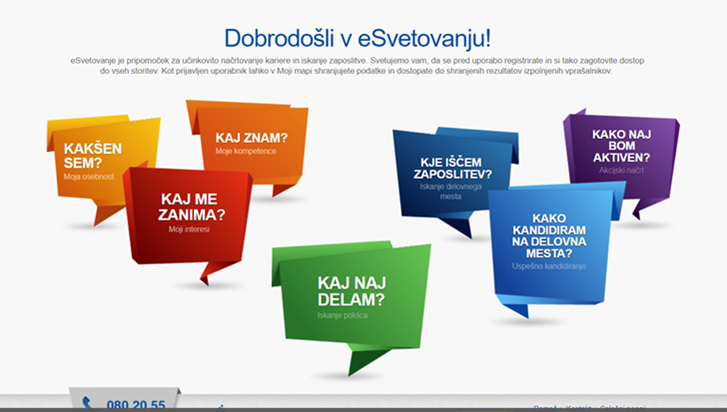
Figure: E-Counselling tool (permission granted). Source:Employment Service of Slovenia
Career Guidance Point (VKO točka)
The Career Guidance Point (October 2022 to June 2026) was created within the project National coordination point for lifelong career guidance at the Employment Service of Slovenia. The one-stop website created is aimed at career guidance practitioners in public institutions (schools, adult education centres, PES, etc.). It provides an overview of lifelong career guidance, the work of the National expert group (see section Coordination and collaboration among stakeholders), an extensive online library where relevant guidance materials and resources are collected. This includes a database with tools (scales, questionnaires, and other instruments) developed or adapted through the project. The instruments aim to measure self-perceived skills, career decision-making styles and problems, attitudes towards entrepreneurship and job search for target users.
Other websites and informational materials
Other resources are the platform ‘Find the Job’ (Portal Poiščidelo.si) of the Employment Service of Slovenia. A database of occupational descriptions has been created for employment counsellors, also an open learning resource for quality information and assistance in career decision-making with more than 500 descriptions of occupations and links to the Europass portal.
The large number of newly designed websites, programmes and tools can lead to fragmentation and confusion, needing attention. To improve services for users, there are calls for greater integration, and systematisation of ICT services in lifelong guidance.
Sources
- Boben, D., et al. (2020). e-Multifaktorska baterija testov [e-Multifactor test battery]. Center for psychodiagnostic resources [Center za psihodiagnostična sredstva] and Employment Service of Slovenia. https://www.vkotocka.si/pripomocki/multifaktorska-baterija-testov-za-otroke-mfbt/
- University of Ljubljana. (n.d.). Career centres. https://kc.uni-lj.si/en/
- Vseživljenska karierna Orijentacija točka [Career guidance point]. (n.d.). Home page. https://www.vkotocka.si/
- Employment Service of Slovenia. (n.d.). Vprašalnik o poklicni poti [Career Path Questionnaire ]. https://www.vkotocka.si/pripomocki/evprasalnik-o-poklicni-poti/
- Karierni plac [Career place]. (n.d.). Career Centres for Youth. https://karierniplac.si/
- Employment Service of Slovenia. (n.d.). Opisi poklicev [Database of occupation descriptions]. https://www.ess.gov.si/ncips/opisi-poklicev
- Employment Service of Slovenia (n.d.). eSvetovanje [E-Counseling]. https://esvetovanje.ess.gov.si/
- Employment Service of Slovenia. (n.d.). Home page. https://english.ess.gov.si/
- Holland, J. L., et al. (2008). Hollandov interesni test [Holland core career test]. Center za psihodiagnostična sredstva [Center for psychodiagnostic resources]and Employment Service of Slovenia. https://www.vkotocka.si/pripomocki/hollandov-interesni-test-sds/
- VšečKAM in GREM [I like it and I go]. (n.d.) Career Centres for Youth. https://www.kariera-mladi.si/
- Institute of the Republic of Slovenia for Vocational Education and Training. (n.d.). Home page. http://www.cpi.si/en/
- Institute of the Republic of Slovenia for Vocational Education and Training. (n.d.). Moja izbira [My choice]. https://www.mojaizbira.si/
- Nacionalna koordinacijska točka za vseživljenjsko karierno orientacijo, NKT VKO [National coordination point for Lifelong career guidance]. (n.d.). Home page. https://www.vkotocka.si/o-nkt-vko/
- Pečjak, S., Podlesek, A. & Pirc, T. (2019). Komplet preizkusov za karierno odločanje v osnovni šoli: priročnik [A set of tests for career decision-making in elementary school: a manual ]. Employment Service of Slovenia. https://www.vkotocka.si/wp-content/uploads/2019/08/Komplet-preizkusov-za-karierno-odlo%C4%8Danje-v-O%C5%A0-priro%C4%8Dnik-1.pdf
- Pečjak, S., Podlesek, A. & Pirc, T. (2019). Vprašalnik težav pri kariernem odločanju za osnovnošolce [Career decision problems questionnaire for basic school students ]. Employment Service of Slovenia. https://www.vkotocka.si/wp-content/uploads/2019/08/Vpra%C5%A1alnik-te%C5%BEav-pri-kariernem-odlo%C4%8Danju-za-O%C5%A0.pdf
- Association of Higher Vocational Colleges. (n.d.). Nacrtujem kariero, ciljam vise [Plan a career, aim higher]. https://www.skupnost-vss.si/nacrtujem-kariero-ciljam-visje/
- Employment Service of Slovenia. (n.d.). Kam in Kako [Where and how].https://www.kaminkako.si/kudos#/
Training and qualifications
Despite calls for better qualification pathways in Slovenia, there is no specialised formal educational degree or dedicated professional qualifications pathway offered in higher education. There are, however, professional development opportunities, training and examinations for career guidance practitioners, and attempts to design lifelong career guidance programmes. The Faculty of Arts offers a formal undergraduate (ISCED 5) and postgraduate (ISCED 6) study programme in Pedagogy and Andragogy, with elements of guidance. Among the learning outcomes listed are that participants should have gained competences in implementing career orientation, though guidance is a minor aspect.
There care calls for improvement of qualification pathways that reflect the multidisciplinary nature of lifelong guidance, need for better collaboration between study programmes, enriched by theoretical and practical elements.
Education sector training
There are general regulations for those employed in the career professions, but without specific job or competence profiles for career guidance staff and no legal requirements for school counsellor training or professional development. School counsellors are granted five training leave days per year, and they may choose any course including in the field of career orientation (career guidance).
National Education Institute of Slovenia
The National Education Institute Slovenia organizes educational activities and events in the field of lifelong career guidance, which are intended for career guidance practitioners in the education system. They prepare materials, consultations, seminars and conduct study groups that also include career orientation (guidance) content. Publications are included e.g., the manual ‘Paths to better career orientation at the secondary level of education’ (Poti do boljše karierne orientacije na sekundardni stopnji izobraževanje; Sultana, 2019), (students aged 11-16).
Training of ‘counsellors’ in adult learning
In the field of adult education, the qualifications of the field ‘counsellors’ working in adult learning are determined by law (Adult Education Act, 2018), including their formal educational background requirements for employment, which is defined and regulated. In-service training is provided by Slovenian Institute for Adult Education (initial and further training) and also by other institutions for specific topics (e.g. communications skills, tools for learning, motivation, career counselling etc.). Their continuing professional development is organised by the Slovenian Institute for Adult Education (SIAE) in accordance with the Act, which defined giudance in adult learning as a public service. These practitioners primarily support learners’ educational pathways, including the recognition of prior learning; however, their guidance role addresses individual needs, where learning and education are closely linked to vocational orientation.
National Coordination Point for Lifelong career guidance (NKT)
Modular education for career guidance practitioners (counsellors)
The first significant shift occurred as part of the National coordination point for lifelong career guidance project (Goršak, 2015), namely the introduction of the Modular training for career guidance practitioner (counsellors) (Modularno usposabljanje kariernih svetovalcev – MUKS), which demonstrates foundational practices. This example was a non-formal education opportunity that didn’t lead to a professional qualification. The training was intended for all employed career guidance practitioners (counsellors) (with completed second cycle of ECTS), who work in the field of education, employment, HR services, non-governmental organizations and are engaged in career counselling or assist individuals in planning and managing their careers. The training consisted of 160 hours, of which at least 140 hours were dedicated to general and practical modules (Lifelong career orientation as a profession; Counsellor and consultant in the counselling process; Theories, models and methods and tools; social groups and group work in lifelong career orientation). Optional modules included (for personnel experts, for school counsellors, for employment counsellors, a module for consultants in non-governmental organizations). By 2020 MTCC was completed by three generations, with a total of more than 150 participants total, in 2015, 2018 and 2020. They provided free of charge training for career guidance practitioners in Slovenia who work in public services.
37 different education programmes and training opportunities were also held, lasting between four and 24 hours and attended by more than 900 different counsellors. Most of the training was aimed at the application of specific and popular counselling tools and methods,
Career guidance practitioners are also trained in the use of tools developed or adapted by the National coordination point (see also above). Several tailored training courses were prepared for the different professional groups providing guidance. Courses were also prepared for NGOs including networking and peer networking, especially those implementing projects for young people aimed to develop life skills.
The Slovenian Institute of Adult Education (SIAE)
Basic and continuous training of counsellors in adult learning
Basic in-service modular training intended for counsellors working in the field of adult education is carried out as a public service, containing six modules of 16 hours, either basic or optional, each provided by Institute for Adult Education.
Continuous professional development is offered at least twice a year to supplement or upgrade basic training and provide andragogic training to all those who lack adequate knowledge, but who require it for work. It offers both training on innovation in the field and specialized and in-depth knowledge to further support innovation in the adult education network, with some training focused on developing ICT support and learning resources.
Employment Service of Slovenia
Professional exam
The Labour Market Regulation Act (ZUTD) (https://pisrs.si/pregledPredpisa?id=ZAKO5710) stipulates the implementation of professional examinations for employees who provide lifelong career guidance and employment placement services. The content of the exam covers knowledge of key laws (e.g. the Labour Market Regulation Act, the Employment Relations Act, etc.), knowledge of the objectives and operation of the PES, followed by content from the field of lifelong guidance. These counsellors also have opportunities to acquire knowledge about other substantive areas of the Employment Service of Slovenia, such as active employment policy, etc.
Euroguidance Slovenia
As a Euroguidance Centre, the Employment Service of Slovenia contributes to the three central objectives of the Euroguidance Network, which is to develop the competencies of career guidance practitioners (counsellors) in education and employment, to raise awareness and provide information on international mobility and on the European dimension of lifelong career guidance. This includes those employed at the Slovenian Employment Service, school counsellors and career guidance practitioners in other organisations.
Sources
- Goršak, M. (2015). Modularno usposabljanje kariernih svetovalcev – MUKS [Modular Training of Career Counsellors - MTCC ]. Andragoška Spoznanja, 21(4), 83–90.
- Sultana, R. G. (2019). Poti do boljše karierne orientacije na sekundarni stopnji izobraževanja [Paths to better career orientation at the secondary level of education]. Employment Service of Slovenia.
Funding career guidance
Most of the funding for lifelong guidance in Slovenia comes from public funds and is organised within the framework of public services, which allows equal access for all people, regardless of their economic status. The activities are financed from two main sources, namely a public service financed from state budget funds and project funds.
At the level of basic and secondary schools and adult education, and as part of the activities of the Employment Service of Slovenia, the majority of activities are financed in the form of public service - public funds. The counselling service in basic and secondary schools is financed by the Ministry of Education. Career guidance in schools is one of the work tasks of school counsellors, which, like in other countries in Europe, often implies limited time for career education and guidance in a systematic and individualised manner.
In adult education, a significant change in the funding of lifelong guidance took place in 2021, when guidance and counselling activities were re-defined as a public service. The Adult Education Act (Zakon o izobraževanju odraslih) includes two activities: counselling in adult learning and education and the ‘Basic school programme’ (ISCED 1-2) for adults to acquire a school leaving certificate. Based on the criteria for the deployment of professionals in the public service, each of the public organisations for adult education receive funding from 2021 for a certain number of professionals who carry out counselling activities and take care of the implementation of the Basic school programme for adults. The anchoring of guidance and counselling activities in the public service brought a longer-term systemic arrangement for adult education (Dobrovoljc, 2021), also with the publication of the Guidelines for Implementing Adult Education Guidance as a Public Service.
The employment and career counselling services of the Employment Service of Slovenia are financed by the Ministry of Labour, Family, Social Affairs and Equal Opportunities, which employs between 250 and 300 counsellors (2022).
The system of public funding is supplemented by various project funds, especially the European Social Funds and the EU Cohesion Policy funds. Thus, a large part of the activities in the field of lifelong guidance is financed by European projects that enable rapid development in individual areas, e.g. the development of services, instruments, programmes, and tools, most of which eventually are available to the public free of charge. Within the Employment Service of Slovenia, for example, occupational descriptions and "Where and how" are provided (payment for a licence to use the "Where and how" programme is financed by the Ministry of Labour, Family, Social Affairs and Equal Opportunities and it is available to users free of charge); the European Union co-finances Euroguidance activities within the Erasmus+ programme. Certain financial resources are also allocated to lifelong guidance in policy areas for targeted projects (e.g., agricultural policy for rural development)
There are a number of shortcomings observed in funding mechanisms and organisation of funding, to ensure stability and continuity of services. For example, some projects are funded without adequate implementation, resulting in duplication of work and discontinued projects (e.g., career counsellors are trained within the project, but work elsewhere after the project ends). Stakeholders interviewed (10 October 2022, Internal report, Slovenian Ministry of Education) suggested improvements in creating a system whereby individual project results feed into system improvement and are supplemented, developed, and improved beyond the project’s end.
In addition, the financing of career guidance at higher vocational education is not systematically regulated. Career guidance activities are expected from higher vocational colleges (the Slovenian Quality Assurance Agency for Higher Education defines them as a criterion in the external quality assessment of higher vocational colleges), but they are not formally defined as a task in other policy documents, nor are they evaluated in relation to financing. The Association of Slovene Higher Vocational Colleges as an umbrella organization has received some funding since 2018 from the Ministry of Education for the development of guidance related career activities, including informative, training and educational events, etc. Funds are granted on an annual basis and there is no clarity on their extension.
Some funding is derived from private sources, i.e., employers who have established career guidance activities for their employees. In particular, larger employers and organizations appear to have better structured, developed, and organized HRD systems, led by professionals in the career field, which may include cooperation with external institutions. More problems are encountered by MSMEs, where lifelong guidance or career development activities are less integrated into the work context.
Sources
- Drzavni zbor Republike Slovenije [National Assembly]. (2018). Zakon o izobraževanju odraslih [Adult Education Act].Uradni list RS, št. 6/18. https://www.uradni-list.si/glasilo-uradni-list-rs/vsebina/2018-01-0222?sop=2018-01-0222
- Nacionalna agencija Republike Slovenije za kakovost v visokem šolstvu [National Agency of the Republic of Slovenia for Quality in Higher Education]. Merila za zunanjo evalvacijo višji strokovnih šol [Criteria for the external evaluation of higher vocational colleges]. (2018). Uradni list RS, št. 21/18 in 69/18. http://www.pisrs.si/Pis.web/pregledPredpisa?id=MERI46
- Dobrovoljc, A. (7. 1. 2021). Consulting service in adult education as a public service [Svetovalna dejavnost v izobraževanju odraslih kot javna služba]. The Slovenian Institute of Adult Education. https://enovicke.acs.si/svetovalna-dejavnost-v-izobrazevanju-odraslih-kot-javna-sluzba/
- Dovžak, K., et al. (2020). Guidelines for Implementing Adult Education Guidance as a Public Service. The Slovenian Institute of Adult Education. https://www.acs.si/en/digital-library/guidelines-for-implementing-adult-education-guidance-as-a-public-service/
- Employment Service of Slovenia. (n.d.). Home page. https://english.ess.gov.si/
- Ministry of Labour, Family, Social Affairs and Equal Opportunities. (n.d.). Home page. https://www.gov.si/en/state-authorities/ministries/ministry-of-labour-family-social-affairs-and-equal-opportunities/
- Ministrstvo za izboraževanje, znanost in šport [Ministry of Education, Science and Sport]. (2020). Pravilnik o standardih in normativih za financiranje in izvajanje javne službe na področju izobraževanja odraslih [Rules on norms and standards for funding and provision of public service in adult education]. Uradni list RS, št. 180/20. https://www.uradni-list.si/glasilo-uradni-list-rs/vsebina/2020-01-3135/pravilnik-o-standardih-in-normativih-za-financiranje-in-izvajanje-javne-sluzbe-na-podrocju-izobrazevanja-odraslih
Career guidance for school pupils
Lifelong guidance activities for school-age youth mostly take place within educational institutions. Slovenia has a formalised (e. g. White Paper on Education in the Republic of Slovenia, Organisation and Financing of Education Act, Basic School Act, Gymnasium Act, Vocational Education Act), well-developed system of school counsellors with multiple roles working in all educational institutions embedded in the system (preschools, schools, dormitories for secondary school students) and providing guidance and counselling for children, pupils and secondary school students. The minimum standards for lifelong guidance and the forms of activities and actors in guidance for school-age youth are formalised and defined in Guidelines for Counselling Practice in Education Programs for School Counsellors (Programske smernice svetovalnega dela v programih vzgoje in izobraževanja).
Several online platforms and tools provide support to school counsellors in informing students or developing their skills to manage their own careers, for example:
- Where and how (Kam in kako; 2 forms - for youth and for adults)
- My choice (Moja izbira; 9th grade students, other young people, parents, school counsellors, and guidance professionals)
- Occupation descriptions (Opisi poklicev)
Young people who have completed compulsory basic education, are older than 15and are enrolled in the education system can also gain various forms of work experiences and learn about different work environments through ‘student work’ - the Slovenian system of student work. Student work, a programme providing for work experience through different employers in cooperation with career guidance providers, is an important source of work experience and a bridge to regular employment for many young people, especially for students whose formal education does not include structured work-based learning opportunities or where such opportunities are limited in duration (e.g. 2 weeks in the last year of study). According to a study conducted by the Ninamedia agency (Dnevnik, 2012), more than 50 % of young people were subsequently employed by an employer where they previously undertook student work. Moreover, "70 % of respondents believed that student work has helped them learn about the labour market and companies, around two-thirds considered that student work has helped them learn about their own potential and define career goals" (Dnevnik, 2012). In addition, guidance services for school-age youth are also provided by various other organisations, such as career centres for youth, the Nefiks Institute, etc. The Nefiks Institute (Zavod Nefiks), for example, provides professional support to young people and youth organisations in recording and documenting informal education and other youth work experiences with the aim of increasing their recognition in society. The “Moje izkušnje [My experience]” project, implemented by the e-Študentski Servis in collaboration with the Nefiks Institute, received an award from the ILO (ILO, 2013). Moje izkušnje was awarded with the second prize of the Call for good practices on decent work for youth an initiative launched by the Youth Employment Unit (YEP) of the International Labour Organization (ILO). The experience tracking system Moje izkušnje is a tool for validation and recognition of working experience, gained by student work (Cedefop, 2018).
Sources
- Državni zbor Republike Slovenije [National Assembly]. (2006). Zakon o osnovni šoli [Basic School Act]. Uradni list RS, št. 81/06. https://www.uradni-list.si/glasilo-uradni-list-rs/vsebina/2006-01-3535?sop=2006-01-3535
- Cedefop (2018). European inventory on validation of non-formal and informal learning 2018 update: Slovenia. https://www.cedefop.europa.eu/fi/country-reports/european-inventory-validation-non-formal-and-informal-learning-2018-update-slovenia
- Rupar Brigita, et al. (2024). Programske smernice svetovalnega dela v programih s področja vzgoje in izobraževanj. [Guidelines for Counselling Practice in Education Programs]. National Education Institut Slovenia. https://www.gov.si/assets/ministrstva/MVI/Dokumenti/Srednja-sola/Programske-smernice-svetovalnega-dela-v-programih-s-podrocja-vzgoje-in-izobrazevanja.pdf
- Dnevnik (2012). Raziskava: Delo v času študija pozitivno vpliva na iskanje prve zaposlitve [Research: Working while studying has a positive effect on finding a first job]. https://www.dnevnik.si/1042396527
- Državni zbor Republike Slovenije [National Assembly]. (2007). Zakon o gimnazijah [Gymnasium Act]. Uradni list RS, št. 1/07. https://www.uradni-list.si/glasilo-uradni-list-rs/vsebina/2007-01-0002?sop=2007-01-0002
- VšečKAM in GREM [I like it and I go]. (n.d.). Career Centres for Youth. https://www.kariera-mladi.si/
- International Labour Organisation. (2013). The ILO call for good practices on youth employment. Summary report. https://www.shareweb.ch/site/EI/Documents/VSD/Topics/Youth%20Employment/ILO%20-%20Summary%20Report%20-%20The%20ILO%20call%20for%20good%20practices%20on%20youth%20employment%20-%202013%20-%20en.pdf
- Institute of the Republic of Slovenia for Vocational Education and Training. (n.d.). Moja izbira [My choice]. https://www.mojaizbira.si/
- Nefiks Institute [Zavod Nefiks]. https://nefiks.si/
- Employment Service of Slovenia. (n.d.). Opisi poklicev [Occupation descriptions]. https://www.ess.gov.si/ncips/opisi-poklicev
- Državni zbor Republike Slovenije [National Assembly]. (2007). Zakon o organizaciji in financiranju vzgoje in izobraževanja [Organisation and Financing of Education Act]. (Uradni list RS, št. 16/07. https://www.uradni-list.si/glasilo-uradni-list-rs/vsebina/2007-01-0718?sop=2007-01-0718
- Državni zbor Republike Slovenije [National Assembly]. (2006). Zakon o poklicnem in strokovnem izobraževanju [Vocational Education Act]. Uradni list RS, št. 79/06.
- https://www.uradni-list.si/glasilo-uradni-list-rs/vsebina/2006-01-3449?sop=2006-01-3449
- Employment Service of Slovenia. (n.d.). Kam in kako [Where and how]. https://www.kaminkako.si/kudos#/
- Ministrstvo za izobraževanje, znanost in šport. (2011). Bela knjiga o vzgoji in izobraževanju v RS [White Paper on Education in the Republic of Slovenia]. http://pefprints.pef.uni-lj.si/1195/1/bela_knjiga_2011.pdf
Guidance for VET participants
In Slovenia, IVET is provided in public schools, where school counselling services operate as an important, autonomous professional support system. The professional framework for counselling is defined by the Programme Guidelines for Counselling Work in Educational Programmes – Counselling Service in Secondary Schools. These guidelines establish a conceptual and operational framework for all educational professionals working in school counselling. One of the key areas defined is career orientation for IVET students. In this area, school counsellors mainly take on a coordinating role—they plan and deliver group-based basic career counselling activities and co-develop the school's personal career plan in cooperation with other professionals.
Teachers are also expected to be involved in career planning, particularly in subjects where students engage directly with employers—such as during work-based learning or apprenticeship training. Since the guidelines adopted in 2024 are more general than the previous ones, the role of teachers are to be more clearly defined as a follow up. Career orientation activities in vocational programmes are typically carried out as extracurricular activities often involving external career practitioners or company visits. Students are entitled to at least one individual career counselling session in their final year.
At the Centre of the Republic of Slovenia for Vocational Education is an initiative called Modernisation of Vocational Education. One of its key aims is to integrate key competencies into revised VET programmes—among them are career management skills (CMS). Students are expected to develop this competence through a variety of learning situations in IVET. Training is provided to development teams at selected schools, which will pilot five revised programmes, also with content related to CMS.
VET programmes enable learners to connect with potential employers and explore occupational roles through work-based learning. Representative chambers, business associations, and companies—granted a public mandate by the relevant sectoral ministry through a public call—are actively involved in VET implementation. Their responsibilities include conducting master, foreman or managerial examinations, performing professional supervision of trainees’ practical training, maintaining registers of training placements, and—in cooperation with schools—executing the practical parts of final examinations (19. člen Zakona o poklicnem in strokovnem izobraževanju; Article 19 of the Vocational and Technical Education Act – ZPSI-1).
Both IVET and CVET are delivered through publicly accredited vocational programmes that lead to the same nationally recognised diploma but offer diverse contexts for career development. CVET can be provided by both public schools and other educational institutions listed in the public register maintained by the Ministry of Education. Although adult learners in CVET obtain the same qualification as those in IVET, their educational pathways differ and a significant number who transition from IVET to CVET, discontinue the former, often seeking alternative pathways to obtain a vocational qualification. Adult learners usually enrol in CVET to acquire new, field-specific qualifications and skills, either to meet changing labour market demands or to refresh and upgrade their competences—often in the context of a career transition.
Public schools that offer CVET employ professionals who coordinate and organise the delivery of these programmes. According to legislation, the only mandatory counselling-related task in adult secondary education is the development of a personal education plan for each participant. Career guidance is not a standard part of counselling services in secondary-level CVET. However, CVET learners are also required to participate in practical training with employers, where they develop their professional identity and career management skills. Unlike younger students, adult learners are expected to take a more active role in identifying and securing suitable employers for their practical training.
There are also short-cycle higher vocational programmes. Approximately half of students are enrolled on a full-time and half on part-time basis. Career guidance is not funded or formally defined as a task, though most colleges provide some career-related support to meet student needs. Practical training empowers students to develop their career pathways in partnership with employers. The Association of Slovene Higher Vocational Colleges also provides some career support through organising various training events for school and career guidance practitioners (counsellors) and teachers, and for students are networking events with employers. The community develops ICT tools to enable them manage their careers. (e.g., Plan a career, aim higher (Načrtujem kariero, ciljam višje), Career e-Learning).
IVET and CVET participants can participate in EuroSkills/SloveniaSkills, a European competition for young professionals aged 18-25 who compete every two years in a different European city in vocational skills in more than 40 different professions.
Source
- Višje strokovne šole [Association of Slovene Higher Vocational Colleges]. (n.d.). Home page. https://www.skupnost-vss.si//
Guidance for higher education students
Higher education students have access to lifelong guidance and career counselling services mainly through career centres, which place a strong emphasis on ensuring quality and consistency in the support they provide. In addition, students, faculty members, and other university stakeholders often organise career-related events and initiatives, creating a diverse and complementary ecosystem of career support.
Career centers operate within universities and faculties and are also evaluated through a quality indicator by the Slovenian Quality Assurance Agency for Higher Education (NAKVIS) (See section on Quality Assurance). The main goal of career centres is to empower students to make informed decisions about their education and future careers. To achieve this, they offer individual and group career counselling, provide lifelong career guidance, and actively build bridges between higher education institutions, employers, and the broader community.
This collaboration adds value for students, as it encourages the exchange of experiences, promotes mutual understanding, and incorporates real-world insights into career-related activities. By facilitating smoother transitions to the labour market and enhancing employability, career centres play a key strategic role in aligning academic experiences with labour market expectations.
Workshops and training courses are offered to students, such as online CV design, speed dating with employers, etc. In addition to employment-related activities, the career centres promote career development skills. Career centres are taking steps to move closer to their users, in particular by making services widely accessible in a digital environment. (An accessibility statement is available, and student feedback is welcomed.) Various online tools such as the POPR portal and personalised work programmes (e.g., Career centres) are available.
Activities are also available to students from informal guidance providers and NGOs that are active in the local environment (e.g. KROJ network, Nefiks) and target specific groups of young people. In addition, a number of student associations (e.g., the Slovenian Psychology Students' Association, the Slovenian Medical Students' Association, the Student Section of the Public Relations Association) offer career guidance activities (e.g. career fairs, training, networking with employers, project work learning).
Guidance for adult learners
The Slovenian Institute of Adult Education (SIAE) is Slovenia's leading institution for adult education. There are also IGAE centres within the SIAE. A significant shift in the funding of lifelong guidance took place in 2021, when the adult education counselling service was designated as a public service (Adult Education Act - Zakon o izobraževanju odraslih (ZIO-1)). This has given adult education guidance activities a longer-term systemic and funding structure. This means that lifelong guidance services are available to adults at the 35 adult education centres. The SIAE ensures both the professional competence of the counsellors and the regular monitoring of the quality of the counselling process. Their work ensures quality of lifelong guidance services for adults. SIAE offers both face-to-face and e-consultation services to adult learners.
The main responsibilities for adult education counsellors include providing information and guidance on educational opportunities and lifelong learning; supporting adults in planning their learning and career pathways; identifying individual learning needs, competences and learning barriers; supporting adults in the identification and documentation of prior learning, including knowledge, skills and competences acquired through formal, non-formal and informal learning, and referring them, where appropriate, to formal validation procedures involving assessment and certification; promoting lifelong learning and successful participation in education; supporting self-directed learning; and referring adults to appropriate education providers or other specialised support services where needed.
Guidance for the employed
Employment relationships are governed by the Labour Market Regulations Act (Zakon o delovnih razmerjih (ZDR-1)) (Official Gazette of the Republic of Slovenia, No. 21/13). Article 170 of the Act establishes the right and obligation of workers to "continuing education, training and skills development following the needs of the work process, for the purpose of maintaining and expanding their capacity to perform the work under the employment contract, and for the purpose of maintaining the employment relationship and increasing their employability." This provision (in particular, the part referring to training to increase employability) indicates that employee training is also carried out to broaden or deepen the competencies that increase the competitiveness of employees in the labour market and thus constitutes a critical measure to support career development at work. Article 170 of the Act also stipulates that if an employer refers an employee for training, the employer shall bear all the training costs, including the employee's right to paid training leave (Article 171 of ZDR-1).
Research and practice have long highlighted the differences in systems and employee management practices between organisations of different sizes (Delaney & Huselid, 1996; Jackson & Schuler, 1995). Contemporary studies suggest that the size of an organisation is not the only factor influencing the degree of development of an employee management system (Wu, 2020). Stakeholders interviewed concurred with this (10 October 2022, Internal report, Slovenian Ministry of Education). They pointed out that the quality of in-company career guidance, or its availability to employees, depends mainly on the policies and resources of individual companies including size of the organisation, a significant factor cited in developing an employee management system and integrating lifelong career guidance practices. Career development support is normally provided by employers for their staff. The employer human resource management and HR staff may cooperate with the Employment Service. This can include their training, guidance and other learning opportunities, such as through the Employer Liaison Offices (Pisarne za delodajalce) at the Employment Service’s Regional Offices.
There are a number of practices related to networking and the active involvement of other partners in the lifelong guidance system, such as i) trade union organisations, with their information and guidance activities and projects (e.g. the Association of Free Trade Unions of Slovenia), ii) the Association of Employers of Slovenia with its training activities and its magazine for employers, iii) the Chamber of Commerce and Industry of Slovenia with its thematic projects, the activities of its Institute for Business Education and other training programmes, and the iv) Chamber of Craft and Small Business of Slovenia with its 62 regional chambers, its involvement in projects such as STAR-VITAL and POLET, which are focused on promoting the healthy and active ageing of employees, and the MASTER 4.0 project, aimed at innovations in the field of master craftsman’s examinations, and thus on improving the opportunities for employees to advance or develop their careers or open a business. Another example is the activities of the Public Scholarship, Development, Disability and Maintenance Fund of the Republic of Slovenia. The Competent Slovenia project (Public Scholarship, Development, Disability and Maintenance Fund of the Republic of Slovenia; for employees and companies) and Competence Centres for Human Resource Development are projects that systematically promote and develop human resources in companies with the support of external partners. The Public Scholarship, Development, Disability and Maintenance Fund of the Republic of Slovenia has implemented the project Integration of People at Risk of Losing Their Jobs in Labour Market Policy Measures (SPIN) (Vključevanje oseb, ki so pred izgubo zaposlitve, v ukrepe na trgu dela (SPIN)). The aim of the project is to promote through labour market policy measures, the integration of people at risk of losing their jobs or whose jobs are at risk (Public Scholarship, Development, Disability and Maintenance Fund of the Republic of Slovenia, w.d.). Furthermore, the Slovenian Institute for Adult Education implemented the project Guidance for employees 2016–2022, funded by the Ministry of Education, Science and Sport and the European Social Fund. The project targets employees facing career changes. It includes activities aimed at "maintaining employment, greater flexibility in employment and further career development of employees associated with their enrolment in further education and certification of already acquired knowledge" (Slovenian Institute for Adult Education, 2022). This project focused on high-risk groups in the labour market, i.e. those with lower educational attainment and working adults over 45 who do participate in any form of adult learning.
Sources
- Delaney, J. T. & Huselid, M. A. (1996). The impact of human resource management practices on perceptions of organisational performance. Academy of Management Journal, 39, 949–969.
- Državni zbor Republike Slovenije [National Assembly]. (2013). Zakon o delovnih razmerjih (ZDR1) [Employment Relationships Act]. Uradni list št. 21/2013. https://www.uradni-list.si/glasilo-uradni-list-rs/vsebina/2013-01-0784?sop=2013-01-0784
- Jackson, S. E. & Schuler, R. S. (1995). Understanding human resource management in the context of organizations and their environments. Annual Review of Psychology, 46, 237-264.
- Public Scholarship, Development, Disability and Maintenance Fund of the Republic of Slovenia. (n.d.). Vključevanje oseb, ki so pred izgubo zaposlitve, v ukrepe na trgu dela (SPIN) [Integration of People in Risk to Lose Their Jobs in Labour Market Policy Measures (SPIN)] https://www.srips-rs.si/razvoj-kadrov/vkljucevanje-oseb-ki-so-pred-izgubo-zaposlitve-v-ukrepe-na-trgu-dela-spin
- Jackson, S. E. & Schuler, R. S. (1995). Understanding human resource management in the context of organisations and their environments. Annual Review of Psychology, 46, 237-264.
- Slovenian Institute for Adult Education. (2020). Projects: Guidance for employees 2016–2022. https://www.acs.si/en/projects/esf-projects/guidance-for-employees-2016-2021/
- Wu, N. (2020). Small Is Beautiful or Big Is Better: How Much Do Industry and Family Ownership Matter in Firms of Different Sizes?. European Management Review, 17(4), 977–991.
- Wu, N. (2020). Small Is Beautiful or Big Is Better: How Much Do Industry and Family Ownership Matter in Firms of Different Sizes? European Management Review, 17(4), 977–991.
Guidance for unemployed adults
The Employment Service of Slovenia (ESS) is the central public labour market institution responsible for unemployment services and the provision of lifelong career guidance. Its services are available not only to unemployed persons but also to jobseekers, pupils, students and employers. Employment counselling and lifelong career guidance are provided in accordance with the Labour Market Regulation Act.
Each unemployed person is assigned a personal employment counsellor, who works with the individual to identify employment goals, assess skills and competences, prepare an individual employment plan, support active job search, and facilitate access to suitable vacancies, training opportunities and active labour market programmes. Employment counsellors also monitor the implementation of the agreed employment plan and provide continuous support throughout the job-search process.
Career counsellors, on the other hand, support unemployed persons, jobseekers and young people in making informed career decisions, planning career development and managing career transitions. Their services include career assessment, individual and group career guidance, information on education, occupations and the labour market, career management skills development, and referrals to education and training where appropriate. Career guidance services are also delivered through the ESS Career Centres.
The activities of both employment counsellors and career counsellors are systematically regulated and publicly funded. Where appropriate, clients may also be referred to guidance, education and training services provided by other organisations within the lifelong guidance system.
The Employment Service of Slovenia (2013; w.d.) provides basic and in-depth career counselling as a part of its employment services. The counselling process is based on cooperation between the employment counsellor and the client and focuses on supporting clients in achieving employment goals. In basic counselling, the client and the counsellor jointly explore employment opportunities, establish realistic employment goals and define the steps needed to achieve them. High-quality placement is based on individuals’ self-awareness of their competencies and their ability to present them appropriately in the labour market.
Other support services, such as related to motivation, addressing barriers and referring clients to further learning opportunities, support this main objective. During in-depth career counselling, clients are supported in exploring new occupational fields, identifying the need for additional knowledge, competences and skills for (re-)entering the labour market, and finding ways to acquire them. They also receive support in developing career planning, career management and decision-making skills, as well as in overcoming complex barriers to employment. Rehabilitation counselling represents one form of in-depth career counselling and includes information and guidance on the rights of persons with disabilities, assessment of employment possibilities, support in initiating and implementing occupational rehabilitation procedures, and preparation of an assessment of employment options (Employment Service of Slovenia, 2013; w.d.).
Sources
- Employment Service of Slovenia. (2013). Svetovalna obravnava VKO. Priročnik [Counselling in Lifelong Career Guidance. Handbook]. [Internal material of the Employment Service of Slovenia]
- Employment Service of Slovenia. (n.d.). Doktrina dela z delodajalci, brezposelnimi osebami in iskalci zaposlitve [Work protocol with employers, unemployed and job seekers]. [Internal material of the Employment Service of Slovenia.]
Guidance for older adults
Older adults at mid-career stage and through retirement have access to lifelong guidance services either through the Employment Service of Slovenia (ESS) or through IGAE centres across Slovenia. This may include adults aged 45 up to the general retirement age and above depending on the context, such as retirement ages for specific occupational groups (e.g., agricultural workers) or in terms of digital skills needs, and other needs for all older adults beyond formal retirement.
The ASI project Comprehensive Support to Enterprises for Active Ageing of the Workforce (ASI Celovita podpora podjetjem za aktivno staranje delovne sile), implemented under the auspices of the Public Scholarship, Development, Disability and Maintenance Fund of the Republic of Slovenia (from 2017 to 2022) was co-financed by the Ministry of Labour, Family, Social Affairs and Equal Opportunities and the European Union under the European Social Fund. The main aim is to extend the working life of employees by strengthening their competences, to eliminate stereotypes about older employees and to empower employers to manage an ageing workforce. Companies can receive financial incentives to develop strategies and strengthen the competences of older workers, and to develop and implement innovative solutions to maintain their commitment, productivity, and efficiency. Various tools include a Catalogue of actions for effective management of older workers (Katalog ukrepov za učinkovito upravljanje starejših zaposlenih) and events.
Guidance for early leavers
One of the major challenges noted in the area of supporting prevention and intervention early school leaving is the lack of systematic follow-up of early school leavers on a national level. The lack of a proper legal basis and measures on sensitive and personal data protection have been a challenge in monitoring school leavers. This also presents problems for career guidance providers when those at risk or who early leavers do not approach services, and where outreach is not in place. Those who register as unemployed can access career support services at the Employment Service (ESS) or through skills-building and vocational qualification programmes (e.g. Project Learning for Young Adults, described in the next section Guidance for NEET).
In the project MIND+ (Renovation of vocational education 2016 – 2021)“Prenova poklicnega izobraževanja 2016-2021”), the Institute of the Republic of Slovenia for Vocational Education and Training developed and tested tools that promote the introduction of individualization as a didactic principle. Schools and teachers plan and implement lessons inclusively to ensure each learner has the opportunity to acquire knowledge and develop his or her abilities, skills and personality traits. This method intended to prevent early leaving and increase learning and better outcomes, where support is embedded in the learning programme.
Guidance for NEET
According to Eurostat (2026), the percentage of NEETs (young people not engaged in education, employment or training) in Slovenia in the 15–29 age group is 8.1 % for women and 7.1 % for men. This rate is relatively low compared to the EU average (10.0 % for men and 12.1 % for women). Despite the comparatively favorable figures, career guidance support for this group should not be overlooked.
Project-Based Learning for Young Adults Plus (PUM-O+) is a programme specifically targeting NEETs. As a non-formal education initiative, it aims to empower young adults aged 15–29 and enhance their employability, with the main objective of supporting labour market integration and facilitating participants’ transition towards employment. The programme includes elements of career guidance, such as mentoring and support in building professional networks.
Higher Vocational Colleges in Slovenia also implement initiatives to attract and engage young people who are outside the education, training, and labour market systems.
The cornerstone of the PUM-O+ programme is structured networking and cooperation with various stakeholders who can support participants in achieving their goals. The official PUM-O+ programme document (Program PUM-O+), developed by the Slovenian Institute for Adult Education (SIAE), outlines the programme’s objectives, training scope, participant integration process, and completion requirements. The programme is implemented under the auspices of the Employment Service of Slovenia (ESS) and is offered at multiple locations nationwide.
In 2018, the PUM-O Performance Evaluation Report (Vrednotenje uspešnosti programa PUM-O) concluded that more than 25% of participants secured suitable employment upon completion, and over half maintained contact with their mentors and fellow participants. However, the report also recommended strengthening the involvement of local operators and ensuring more coordinated action among all stakeholders.
Source
- Eurostat. (2026). Statistics on young people neither in employment nor in education or training. https://ec.europa.eu/eurostat/statistics-explained/index.php?title=Statistics_on_young_people_neither_in_employment_nor_in_education_or_training
Guidance for young people at risk
Lifelong guidance for young people from at-risk groups unfolds in partnership between the key guidance providers including guidance counsellors), the relevant institutions and/or (non-governmental) organisations, which identify the needs of each group in their work. For example, the University of Ljubljana Career Centres cooperate with various NGOs in planning and preparing targeted activities and offer young people from at-risk groups, for example in tailoring individual counselling.
Guidance for persons with disabilities
For individuals with a disability (including specific learning needs) who are enrolled in educational programmes, lifelong guidance mostly takes place in the educational institutions in which they are enrolled. In particular, educational institutions dedicated to the education and training of children and youth with specific needs pay great attention to the career orientation of their students. One of the major educational institutions in Slovenia is the Special Education Centre Janez Levec. As part of its activities, the centre has also established the Labour and Employment Centre Janez Levec, which provides social assistance services in the form of career counselling, care and employment in specific conditions, as well as the Employment Centre Janez works (Janez dela – Zaposlitveni center).
In addition, at certain levels of the Slovenian educational system (vocational education, higher vocational colleges), special attention is paid from the point of view of an individualised approach and the particular needs of the students, including barriers faced and opportunities and measures in education and training, and for employment support available in the labour market. This includes definition of the needs, accommodations and finding the right education or learning opportunities.
The Youth Transition project, which represents the association of vocational rehabilitation providers in Slovenia, offers career guidance to persons with disabilities. The project aims to provide professional assistance to young people with specific needs in order to facilitate their transition to higher education and/or the labour market.
There are several companies and organisations in Slovenia that deal specifically with employment and career guidance for persons facing barriers related to disabilities or specific needs. The non-profit company "Želva" offers training and employment to persons with specific needs and disabilities. It was founded in 1991 by "Sožitje" - the Slovenian association for persons with intellectual disabilities at the suggestion of the Employment Service of Slovenia.
Rehabilitation counselling is available, which is a form of in-depth career counselling that the public employment services carry out. It includes information and guidance about the rights of people with disabilities, determining the feasibility of initiating and carrying out the process of determining disability and/or eligibility for occupational rehabilitation, organising and monitoring the implementation of occupational rehabilitation services, and preparing an employment related assessment for a person with a disability (Employment Service of Slovenia, 2013; w.d.).
Sources
- Center Janeza Leveca [Special Education Centre Janez Levec]. (n.d.). Home page.https://www.centerjanezalevca.si/english/
- Prehod mladih [Youth Transition]. (n.d.). Home page. https://prehodmladih.si/en/
- Želva. (n.d.). Home page. https://www.zelva.si/
Guidance for immigrants
For migrants and refugees in Slovenia, career guidance is mainly provided through existing public employment and education services, as well as integration support programmes. It includes basic career services as support in assessing the labour market, searching for employment, preparing applications and CV’s, and understanding employment-related procedures, as well as information on opportunities for further education, training and skills development. Additional support may include assistance with the recognition of qualifications, assessment for competences acquired abroad, and overcoming barriers to language, education and labour market integration. According the Migrant integration policy index, Slovenia had limited support for labour market mobility of migrants compared, however, progress is evident, particularly in strengthening access to education, guidance and integration support for migrants, including educational guidance at different levels of the education system.
In 2019, the Employment Service of Slovenia (ESS) established an Info point for migrant workers, with the aim of providing them and their employers comprehensive support. Prior to its establishment, the project ‘Promoting the employability, education and social inclusion of employees with a migrant background and their families’ was implemented at the ESS. The aim was to increase equal employment opportunities for migrant workers, improve their social inclusion and economic independence, and reduce ‘social dumping’ and violation of workers' rights.
The Info Point for Foreign Nationals is an additional service of the Employment Service of Slovenia, implemented as part of national employment and foreign labour policies. One of its key objectives is to ensure the availability of the necessary workforce.
To address these needs, and alongside the implementation of employment and foreign labour policies, the ESS established the Info Point to provide comprehensive support both to migrant workers and to their employers.
Between 2016 and 2018, the project Holistic Approach for the Successful Integration of Migrants was implemented by the Social chamber of Slovenia, National Institute for Vocational Education and Training, funded by Erasmus+. The aim was to design and establish an integrated approach for the successful integration of people with a migrant background, which would enable dedicated training of experts from different sectors of education, social and health care, labour and employment and other fields. A study was conducted in 2019 on the existing situation and needs regarding the integration of workers from other EU countries.
At national level, persons granted international protection are the responsibility of the Government Office for the Support and Integration of Migrants, which provides basic career guidance as part of the integration process. After successful completion of the asylum procedure, persons granted international protection are assigned an integration counsellor, who works with the beneficiary of international protection to create a personal integration plan based on their needs, knowledge, skills, and abilities. This includes planned activities to support integration into the environment during the first three years after obtaining status. Representatives of the relevant employment office and social work centre, educational institutions, non-governmental organisations, and the local community can also participate in the creation of a personal integration plan. The project Basic integration support for displaced persons from Ukraine with temporary protection in Slovenia (Osnovna podpora pri integraciji za razseljene osebe iz Ukrajine z začasno zaščito v Sloveniji) is financed by the Fund for Bilateral Relations and under the same national office, in cooperation with Slovene Philanthropy. The website and YouTube portal include videos with information on various public services.
Slovene Philanthropy is a non-governmental organisation in Slovenia to support migrants and refugees. Their activities include direct work with asylum seekers, refugees and migrants and are based on an individual, holistic approach, covering all areas of integration, including the labour market, assistance in finding a job, help in attending training, development of talents and skills, and career counselling and guidance.
Stakeholders in Slovenia through the Euroguidance network contributed to joint webinars on career guidance for refugees (EU resources for career guidance for refugees and effective approaches to career guidance for refugees). Information on Slovenia was included in a promotional leaflet supporting lifelong guidance for refugees fleeing the war in Ukraine (Cedefop, 2023).
Sources
- Cedefop (2023). Lifelong guidance policy for Ukrainian refugees in the EU. Flyer. https://www.cedefop.europa.eu/en/publications/8144
- Euroguidance network. (2022, April 19). Euroguidance webinars on guidance for refugees – Recording now available. https://www.euroguidance.eu/news/euroguidance-webinars-on-guidance-for-refugees
- Government of Republic of Slovenia. (n.d.). About the Government Office for the Support and Integration of Migrants.https://www.gov.si/en/state-authorities/government-offices/government-office-for-the-support-and-integration-of-migrants/about-the-office/
- Social chamber of Slovenia, National Institute for Vocational Education and Training, et al. (n.d.). Holistic Approach for the Successful Integration of Migrants. https://www.szslo.si/integration-of-migrants
- Employment Service of Slovenia. (n.d.). Info points for foreigners. https://english.ess.gov.si/the_info_point_for_foreigners
- Institute of the Republic of Slovenia for Vocational Education and Training. (n.d.). SLOVENIASKILLS 2024. https://cpi.si/en/
- Migrant integration policy index. (n.d.). Measuring policies to integrate migrants across six continents. https://www.mipex.eu/
- Sedmak; M., Medarić, Z., Perković, K., & Zadel, M. (2019). Raziskava o potrebah na področju integracije delavcev iz drugih držav članic EU v Sloveniji [Research on the needs in the field of integration of workers from other EU member states in Slovenia]. Institute for social studies. https://www.ess.gov.si/_files/12769/Raziskava_o_potrebah_na_podrocju_integracije.pdf
- Slovene Philanthropy. (n.d.). Help and support with integration. https://www.filantropija.org/migration/help-and-support-with-integration/
Gender-based policies
National legislation (in education and labour market) and strategic documents (e.g. Slovenian Development Strategy 2030) emphasise the need to ensure equality between all individuals. This is foundational for public services and programmes supporting career development. For example, the strategic goal of Slovenia's development by 2030, "Inclusive labour market and quality jobs" (Šooš et al., 2017, p. 36) states that Slovenia strives to ensure equality in the area of lifelong guidance by i) promoting greater inclusion of disadvantaged and underrepresented groups in the labour market; ii) by adapting workplaces and organisations to demographic changes, technology, and climate change; iii) by improving the system of flexicurity and reducing the traps of unemployment and inactivity; iv) by promoting employers' activities to strengthen workers' physical and mental health, occupational safety, and facilitate the coordination of work and care responsibilities; v) by promoting equality in employment .
These strategic goals are reflected in Slovenian legislation, at various regulatory levels and with concrete implementation projects, and are not limited to preventing gender discrimination, combatting stereotypes and prejudices. For example, workforce diversity and equality are emphasised through the ASI Comprehensive Support for an Actively Ageing Workforce project (see section Guidance for older workers).
To these ends, the Day for girls (Dan za punce) was an international project in Slovenia managed by the Ministry of Economic Development and Technology. The project's activities targeted young women making career decisions and included workshops, seminars and workplace visits. In Slovenia, the Dan za punce website presents activities for 2012, 2013 and 2014.
In addition to the projects carried out by national research institutions (e.g. ATHENA, Jozef Stefan Institute as the Slovenian partner in the international project) and other research, education and development institutions, trade unions are also active in this area including career guidance activities. For example, the Association of Free Trade Unions of Slovenia, The Peace Institute and the Association of Employers of Slovenia participated in the international project Men in CARE (MiC) “co-funded by the European Commission under the EaSI program” aimed to “improve workplace conditions to promote men taking caring roles” (Men in CARE, 2022). In Slovenia, the Trade union Mladi plus (Youth Plus) operates under the auspices of the Association of Free Trade Unions of Slovenia, which promotes and protects students' work-related rights and interests, pupils, and unemployed youth (Sindikat Mladi plus, w.d.).
Stakeholders interviewed (10 October 2022, Internal report, Slovenian Ministry of Education) believe that the lifelong guidance system is designed and implemented in a non-discriminatory manner. Different target user groups and individuals, regardless of gender, age, education, ethnic group, or other minorities, according to the umbrella law, Organization and Financing of Education Act (Zakon o organizaciji in financiranju vzgoje in izobraževanja – ZOFVI) defining equal opportunities in education, have access to lifelong guidance as public service. Non-governmental organisations in the wider system also play a role in ensuring this, whose role is mainly informational and promotional, in raising awareness on counselling and guidance. Standards and criteria are provided for NGO partner organisations, who are required to employ a professional with pedagogical or andragogic education and experience in lifelong guidance.
This is confirmed by the Ministry of Labour, Family, Social Affairs and Equal Opportunities in its Equal Opportunities Division - "Proposes, recommends, implements and facilitates programmes and actions aimed at promoting equality between women and men" (Ministry of Labour, Family, Social Affairs and Equal Opportunities, 2020) through gathering data, data analyses and reports, through national programmes and promotional campaigns.
International research (e.g. Babnik, 2010; Bakacsi et al., 2002) indicates that according to public perception in Slovenia, the country has experienced a positive gender equality climate where value is placed on gender equality. Despite positive social practices and social values, key stakeholders expressed the need to increase sensitivity toward individual differences and better integrate equality across the lifelong guidance system (Internal report, Ministry of Education, 2022).
Sources
- Babnik, K. (2010). Vloga societalne in organizacijske kulture v odnosu zaposlenih do dela: doktorska disertacija. [The role of societal and organisational culture in employees’ attitudes towards work: doctoral disertation]. Univerza v Ljubljani Filozofska fakulteta.
- Bakacsi, G., Sándor, T., András, K., & Viktor, I. (2002). Eastern European cluster: Tradition and transition. Journal of World Business, 37(1), 69–80.
- European Network for the Wetwork for the Work with Perpetrators of Domestic Violance. (2022). Men in CARE. https://www.men-in-care.eu/about
- Ministry of Labour, Family, Social Affairs and Equal Opportunities (2020). Equal Opportunities Division. https://www.gov.si/en/state-authorities/ministries/ministry-of-labour-family-social-affairs-and-equal-opportunities/about-the-ministry-of-labour-family-social-affairs-and-equal-opportunities/equal-opportunities-division/
- Sindikat Mladi Plus. (n.d.). Trade union Mladi plus (‘Youth Plus’). https://www.mladiplus.si/trade-union-mladi-plus-youth-plus/
- Šooš, T., et al. (Eds). (2017). Slovenian Development Strategy 2030 [Strategija razvoja Slovenije 2030]. Služba Vlade Republike Slovenije za razvoj in evropsko kohezijsko politiko. https://www.gov.si/assets/vladne-sluzbe/SVRK/Strategija-razvoja-Slovenije-2030/Strategija_razvoja_Slovenije_2030.pdf
Country-specific report details
- Introduction
- Coordination and collaboration among stakeholders
- Access to guidance
- Quality assurance
- Career management skills
- Evidence, monitoring and assessment
- Career information, ICT in guidance
- Training and qualifications
- Funding career guidance
- Career guidance for school pupils
- Guidance for VET participants
- Guidance for higher education students
- Guidance for adult learners
- Guidance for the employed
- Guidance for unemployed adults
- Guidance for older adults
- Guidance for early leavers
- Guidance for NEET
- Guidance for young people at risk
- Guidance for persons with disabilities
- Guidance for immigrants
- Gender-based policies
- Finland
- Luxembourg
- Türkiye
- Finland
- Luxembourg
- Türkiye
- Finland
- Luxembourg
- Türkiye
- Finland
- Luxembourg
- Türkiye
- Finland
- Luxembourg
- Türkiye
- Finland
- Luxembourg
- Türkiye
- Finland
- Luxembourg
- Türkiye
- Luxembourg
- Türkiye
- Finland
- Luxembourg
- Türkiye
- Finland
- Luxembourg
- Türkiye
- Finland
- Luxembourg
- Türkiye
- Finland
- Luxembourg
- Türkiye
- Finland
- Luxembourg
- Türkiye
- Finland
- Luxembourg
- Finland
- Luxembourg
- Türkiye
- Finland
- Luxembourg
- Finland
- Luxembourg
- Finland
- Luxembourg
- Finland
- Luxembourg
- Türkiye
- Finland
- Luxembourg
- Türkiye
- Finland
- Luxembourg
- Türkiye
- Finland
- Türkiye