
Key trends by country
Looking ahead to 2027, the EU labour market is projected to maintain employment growth (+0.4%), although short-term labour market prospects remain uneven across Member States, reflecting differences in economic structure, occupational composition, sector specialisation and exposure to automation and other structural shifts. Where employment is more concentrated in professional, business, digital and care-related occupations, short-term prospects tend to be stronger. Where employment remains more concentrated in traditional production, primary sector or routine support functions, projected growth is generally more moderate. In this sense, overall country performance is closely linked to the occupational mix underpinning it.
Across countries, projected employment growth is most often associated with occupations linked to ICT, business and administration, health, care, and, in some cases, education and service management. These occupations appear repeatedly among the strongest performers in national results, suggesting that digitalisation, demographic change and the continued importance of knowledge-intensive services remain key drivers of short-term labour demand. This also highlights the role of VET, higher VET and continuing training in supporting both initial entry into these occupations and progression within them.
At the same time, the country data point to a more differentiated picture in occupations linked to manufacturing, crafts, clerical support, machine operation and agriculture; In some labour markets these occupations continue to show modest or negative short-term growth. This underlines that occupational change is not uniform across Europe: the same broad occupational field may face different prospects depending on national economic structures, replacement needs, technological adoption and service demand.
The table below highlights the top three trending occupations in each Member State based on the 2027 projections.
| Country | Employment growth (%) | Top 3 occupations (% growth) |
|---|---|---|
Belgium  | 0.7 |  |
Bulgaria  | 0.2 |  |
Czechia  | 0.0 |  |
Denmark  | 0.6 |  |
Germany  | 0.1 |  |
Estonia  | 0.3 | 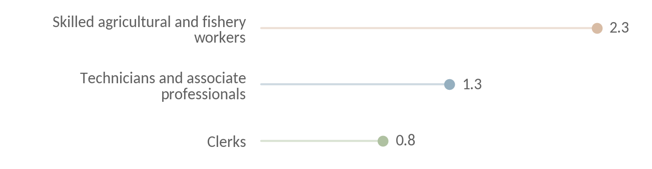 |
Ireland  | 1.4 |  |
Greece  | 0.4 |  |
Spain  | 1.4 |  |
France  | 0.1 | 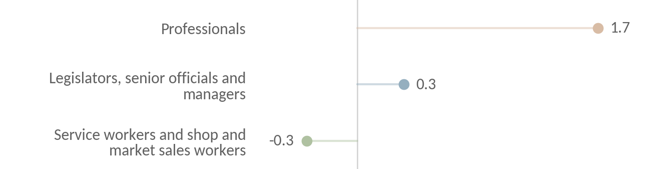 |
Croatia  | 0.7 |  |
Italy  | 0.2 |  |
Cyprus  | 1.1 |  |
Latvia  | -0.3 | 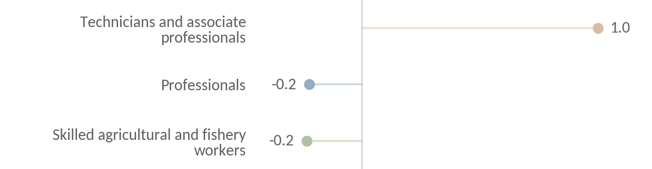 |
Lithuania  | -0.2 |  |
Luxembourg  | 1.6 |  |
Hungary  | 0.1 |  |
Malta  | 3.1 |  |
Netherlands  | 0.2 |  |
Austria  | 0.6 |  |
Poland  | 0.1 |  |
Portugal  | 0.9 |  |
Romania  | 0.5 |  |
Slovenia  | 0.0 |  |
Slovakia  | -0.2 |  |
Finland  | 0.5 |  |
Sweden  | 0.9 | 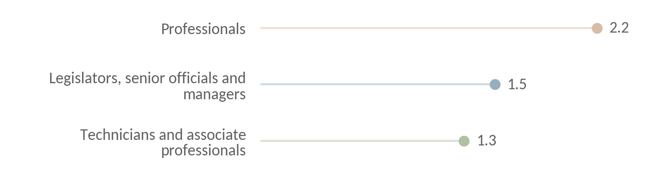 |
Time Horizon and Methodology
The STAS produces projection on employment in the EU up to two years ahead of the last period of available data. The projections presented in the August 2026 bulletin nowcast data for 2026 and forecast data for 2027, relying on EU Labour Force Survey (LFS) quarterly data up to Q1/2026; LFS annual data up to 2025; and data from the EU Job Vacancy Statistics up to 2025. The STAS baseline was then aligned to the forecasted total employment growth published by the Directorate-General for Economic and Financial Affairs (DG ECFIN) in the AMECO database, released in April 2026. The projections are updated with fresh data every six months, following the AMECO spring and autumn releases ensuring that the forecasts remain reflective of the latest employment trends.
The STAS methodology relies on a three-fold econometric modelling approach: a Vector Autoregression (VAR) and Vector Error Correction Model (VECM) method linking sectoral vacancies and employment; a univariate Autoregressive Integrated Moving Average (ARIMA) to model occupational employment; and a “Naïve” forecast based on past average of quarter-on-quarter growth. The STAS uses the EU LFS quarterly and annual data on employment by occupation, sector and Member State as well as vacancy data from the European Job Vacancy Statistics.

Descarregamentos
STAS bulletin Aug 2026